
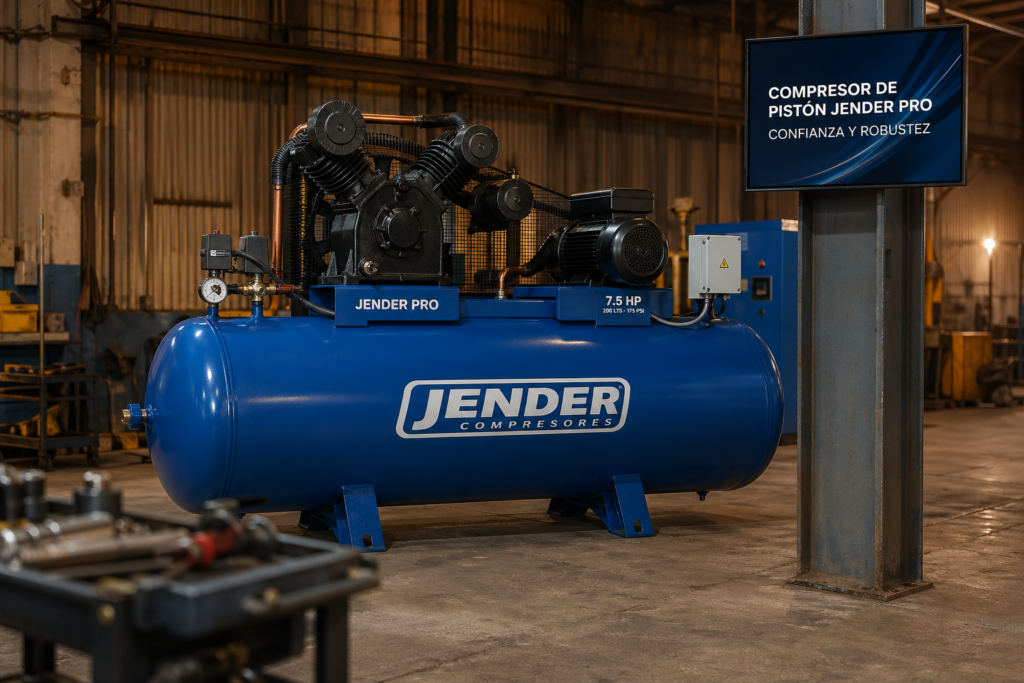
A piston air compressor consists of a pump head that compresses air through the reciprocating motion of one or more pistons, an electric motor that generates the movement, a tank that stores the compressed air, and a control system that regulates the working pressure. These are the most widely used compressors in workshops, carpentry shops, automotive facilities, and DIY applications due to their mechanical simplicity and low maintenance cost.
In this article you will see what each part does, how it fits into the compression cycle, and what signs indicate that something is starting to fail. If you are evaluating which model suits your installation, you can consult the range of Jender piston compressors, with models from 25 to 500 liters for DIY, workshop, and industrial use.
How the Compression Cycle Works
Understanding the cycle helps to comprehend why each part exists. The process has three phases that repeat continuously:
- Intake: the piston moves down inside the cylinder, creates a vacuum, and the intake valve opens to let in air from outside.
- Compression: the piston moves up, the intake valve closes, and the air is trapped in an increasingly smaller volume until it reaches the working pressure.
- Discharge: when the pressure is reached, the discharge valve opens and the compressed air passes into the tank.
Each component exists so that one of these three phases occurs correctly. If a part fails, it does so at one of these three moments.
The Pump Head: Where Compression Occurs
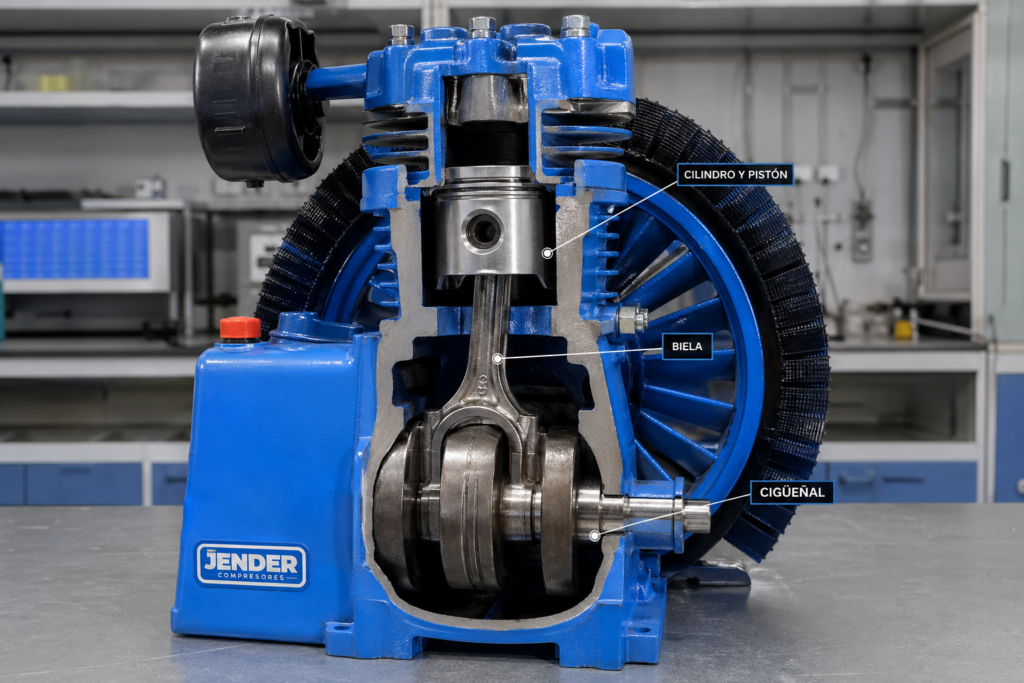
The pump head is the core of the compressor. It contains all the elements that perform the mechanical work of compressing air: cylinder, piston, rings, connecting rod, crankshaft, and valves. In two-stage compressors there are two pump heads in series; the first compresses to an intermediate pressure and the second raises it to the final pressure.
Cylinder and Piston
The cylinder is the chamber where compression takes place. Manufactured in cast iron or aluminum, its internal diameter (the bore) determines the flow rate the compressor can generate. The piston moves inside the cylinder with millimetric precision: too much clearance causes internal leaks and pressure loss; too tight a fit generates heat from friction.
Piston Rings
These are the metal rings that surround the piston and seal the space between it and the cylinder wall. They prevent compressed air from escaping into the crankcase and lubricating oil from rising into the compression chamber. When the rings wear out, the compressor loses the ability to reach maximum pressure and oil appears in the air line.
Connecting Rod and Crankshaft
The crankshaft transforms the rotary motion of the motor into reciprocating linear motion of the piston. The connecting rod is the link that connects both. It is the same principle as an internal combustion engine: the rotation of the crankshaft pushes and pulls the connecting rod, which in turn moves the piston up and down inside the cylinder.
Intake and Discharge Valves
These are high-strength steel metal plates that act as check valves: the intake valve only allows air to pass into the cylinder, and the discharge valve only allows air to pass out. They are wear parts: over time they can crack or lose their seal, which means the compressor takes longer to reach the set pressure or simply does not reach it.
Electric Motor and Transmission System
The motor transforms electrical energy into rotary motion to drive the crankshaft. In most piston compressors the transmission is by V-belt between the motor pulley and the pump head pulley. The belt also acts as a safety element: if there is a mechanical blockage, the belt slips before the motor is damaged.
The pump head pulley usually has a larger diameter than the motor pulley, which reduces the crankshaft rotation speed relative to the motor. This regulates the pump head RPM and directly affects the flow rate generated and the compressor’s service life: lower RPM means less wear. The belt guard protects the operator from moving parts and is mandatory in any installation.
Air Tank
The tank stores the compressed air generated by the pump head and dampens pressure variations between cycles. Manufactured in steel, it withstands working pressures of up to 10-15 bar depending on the model. Its capacity (in liters) determines how long it can supply air without the motor starting again.
At the bottom of the tank there is a drain valve to drain the condensate that accumulates with use. If not purged regularly, water accumulates at the bottom, accelerates internal corrosion, and reduces the tank’s service life. In some models this drain is automatic.
Pressure Switch and Safety Valve
The pressure switch monitors the tank pressure and controls the motor’s start and stop. When the pressure drops below the configured minimum, it starts the motor; when it reaches the maximum, it stops it. It leaves the factory with a predefined range (generally 8-10 bar) and should not be tampered with, as it directly affects the motor and equipment safety.
The safety valve is the last line of protection: if the pressure switch fails and the pressure exceeds the safe limit, the valve opens automatically to release the excess. It is a safety element required by regulation. It should be checked periodically by pulling the test ring to verify that it opens easily.
Air Filter and Oil Sight Glass
The intake filter retains dust, chips, and particles before they enter the pump head. A clogged filter reduces the intake air flow and makes the motor work harder. In dusty or sawdust environments (carpentry shops, woodworking shops) it should be checked weekly.
The oil sight glass allows checking the crankcase lubricant level without opening the equipment. In oil-lubricated compressors, the correct level is critical: without sufficient oil the bearings and crankshaft wear out quickly. There are also oil-free piston compressors, with Teflon pistons that do not require lubrication, designed for applications where air quality is a priority.
Single-Stage vs. Two-Stage: How the Configuration Changes
In a single-stage piston compressor, a single cylinder compresses air from atmospheric pressure to working pressure (typically 8-10 bar). In a two-stage compressor there are two cylinders: the first compresses to an intermediate pressure (3-4 bar) and the second compresses from there to the final pressure (up to 15-16 bar). Between both stages there is usually an intercooler that cools the air before the second compression, which improves efficiency and protects the second cylinder.
The choice between one and the other depends on the pressure and flow rate you need. If you want to better understand which model fits your use, the article on types of piston compressors explains the practical differences between configurations so you can decide with informed judgment.
Most Common Fault Signs by Component
| Component | Typical Fault Sign |
|---|---|
| Deteriorated intake/discharge valves | The compressor takes a long time to reach pressure or does not reach it |
| Worn piston rings | Oil in the air line, high oil consumption |
| Loose or worn belt | Flow loss, squealing noise, motor overheating |
| Clogged air filter | Motor works harder, high temperature, reduced flow |
| Condensate accumulated in tank | Moisture in the air line, visible corrosion at the drain |
| Misadjusted or faulty pressure switch | The motor does not stop or does not start at the correct pressure points |
| Low oil level | Metallic noise in the pump head, high temperature, accelerated wear |
Jender Piston Compressors: European Manufacturing and Technical Support
The Jender piston compressor range covers from compact models for DIY to 500-liter units for continuous industrial use, all with European manufacturing and top-tier components. If you have questions about which model you need or want a technical assessment of your current installation, the Jender team can guide you without obligation.
Consult the complete range and technical specifications of Jender piston compressors to find the equipment that fits your working pressure, flow rate, and duty cycle.



