
A piston compressor compresses air through the reciprocating motion of one or more pistons inside a cylinder. When the piston moves down, it draws in outside air; when it moves up, it compresses it and pushes it into the tank. This cycle repeats continuously, controlled by a valve system that regulates when air enters and when it exits at each phase.
It’s the most widely used compression technology in small workshops and professional applications with moderate demand, precisely because of its simple design, robustness, and accessible price point. If you already know a piston compressor is what you need, you can buy high-quality piston compressors through our website.
The compression cycle step by step
A piston compressor works, essentially, the same way as an internal combustion engine, but in reverse: instead of gas expansion moving the piston, the piston compresses the gas.
The complete cycle has three clearly defined phases:
- Intake: the piston moves down inside the cylinder. This movement creates a vacuum that opens the intake valve and allows outside air to enter the cylinder through the intake filter. During this phase, the discharge valve remains closed.
- Compression: once the cylinder is full of air, the piston reverses direction and starts moving up. The intake valve seals shut and the air is trapped in a space that progressively decreases. As the available volume decreases, air pressure increases. The higher the piston rises, the higher the pressure reached.
- Discharge: when the compressed air pressure exceeds the tank pressure, the discharge valve opens and air flows from the cylinder into the receiver, where it is stored until the pressure switch detects that the set maximum pressure has been reached and stops the motor.
This cycle does not produce a continuous airflow but a pulsating one, which explains why piston compressors always need a tank to act as a buffer for those pulsations before the air reaches the line.
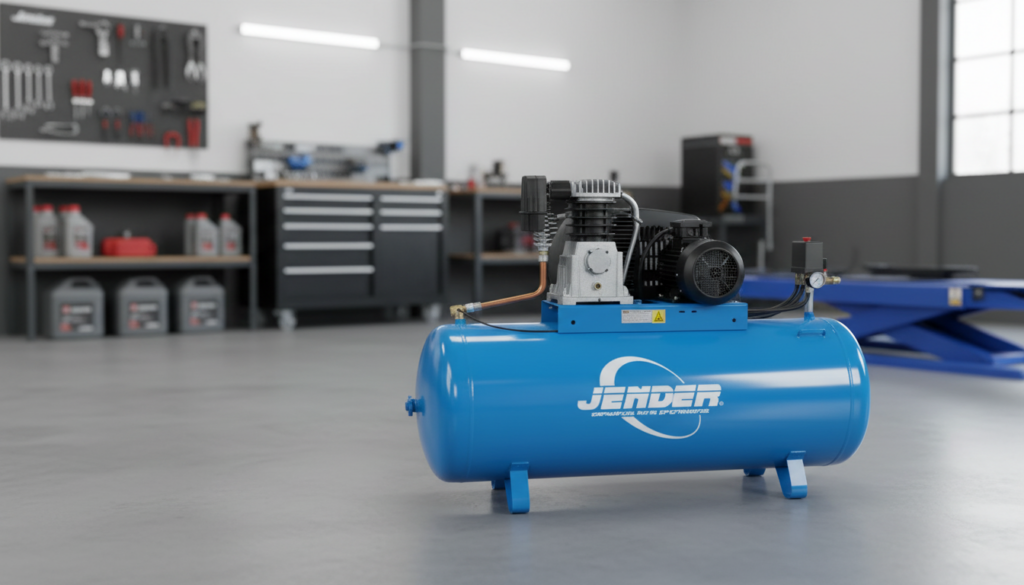
The role of valves in compression
Valves are the components that govern the cycle and largely determine the unit’s efficiency. In most piston compressors they are automatic-acting: they open and close due to the pressure difference on both sides of the valve plate, without any external actuation.
The intake valve is a flexible disc that bends downward when the piston descends, allowing air in. When the piston rises, the pressure difference keeps it closed, preventing air from escaping back through the inlet.
The discharge valve works in a complementary way: it remains closed during intake and compression, and opens only when the cylinder’s internal pressure exceeds the tank pressure. Its condition is critical: a worn discharge valve or a damaged seat is one of the most common reasons a compressor fails to reach working pressure.
Understanding these components well is the first step to knowing where the most common faults can occur. If you want to go deeper into each one, in the article on piston air compressor parts you’ll find a complete breakdown of each component and its function.
Single-stage or two-stage: what changes in operation
The number of stages determines how many times the air is compressed before reaching the tank, and it has direct implications for the maximum achievable pressure and process efficiency.
Single-stage compressors
All cylinders work in parallel and compress the air in a single step, from atmospheric pressure to working pressure. It’s the simplest configuration and the most common in DIY and moderate-power professional compressors. They are suitable for pressures up to 10 bar, which covers most workshop applications.
Two-stage compressors
Compression is carried out in two consecutive phases. In the first, one or more larger-diameter cylinders compress the air to an intermediate pressure. That air passes through an intercooler that reduces its temperature before entering the second stage, where smaller-diameter cylinders compress it to the final working pressure.
Interstage cooling is decisive: hot air is harder to compress and takes up more volume. Cooling it between stages delivers higher energy efficiency, lower discharge temperatures, and the ability to reach pressures of up to 11 bar or higher with less mechanical stress. It’s the standard configuration in higher-power professional ranges, designed for intensive industrial use.
Lubricated or oil-free: implications for operation
In lubricated compressors, oil circulates through the crankcase and lubricates the cylinder walls and piston rings, reducing friction and the heat generated during compression. The resulting compressed air can carry a certain amount of residual oil, typically between 10 and 15 mg/m³, which line filters reduce to levels acceptable for most applications.
In oil-free piston compressors, the piston rings are made from self-lubricating materials such as Teflon or carbon fiber, which do not require external lubrication. The result is oil-free compressed air, suitable for applications where air quality is critical. The trade-off is that these rings wear faster than lubricated ones and require more frequent replacement.
Real-world performance and how to calculate consumption
Not all the air the piston draws in becomes usable compressed air. The compressor’s volumetric efficiency depends, among other factors, on the pump speed:
Piston compressors running at 2,800 rpm have an efficiency factor of 0.65 based on intake air. Those running at lower speeds, between 1,000 and 1,400 rpm, achieve an efficiency factor of 0.75. This means that, for the same displacement, a low-speed compressor delivers more usable air per litre of intake air, while also generating less heat and wearing more slowly.
To calculate a system’s real air consumption and correctly size the compressor, Jender uses the following formula:
C = (S × P / T) × 60 = litres per minute
Where S is the tank capacity in litres, P is the pressure in bar, and T is the time in seconds it takes the tank to drop from maximum pressure to 4 bar with the connected equipment running. This calculation makes it possible to know the system’s real consumption before choosing the equipment, avoiding both undersizing and overspending.
From theory to range: three piston compressor profiles
Operation is the same across all piston compressors, but the configuration varies depending on the intended use profile.
Jender’s piston range covers three distinct profiles: compact coaxial units for DIY and easy transport, professional single-stage models for workshops with moderate demand in single-phase or three-phase configurations, and two-stage models for more demanding industrial use with tanks up to 500 litres and pressures of 11 bar. All are manufactured with components that meet international standards and include CE and TÜV Austria certifications, among others.
If you’re unsure which model best fits your real consumption, our technical team will advise you with no obligation. And if you already know what you need, you can view and buy high-quality piston compressors directly in our store.



