
A screw compressor consists of thirteen components that work in sequence: the air end compresses the air using two helical rotors, the inlet filter protects this process, the separator removes oil from the compressed air, the cooling system controls the temperature, and the control panel coordinates the entire cycle. Understanding what each part does is what allows you to detect a problem before production comes to a halt.
In this article, you’ll learn about each component, its function, and the signs that indicate it’s starting to fail. If you’re looking to understand how air is compressed and the different variations of this technology, we cover that in another guide.
The Journey of Air, Step by Step
The quickest way to understand a screw compressor is to follow the path the air takes from the moment it enters until it reaches the distribution network. Each stage has a specific component responsible for it and its own potential failure mode.
| # | Stage | Component | What happens if it fails? |
|---|---|---|---|
| 1 | Ambient Air Inlet | Inlet Air Filter | Particles enter the air-end, causing a spike in energy consumption |
| 2 | Regulation of the Maximum Flow Rate | Intake valve | The equipment does not meet the target or does not unload |
| 3 | Compression | Air-end and motor | Noise, Vibration, and Flow Loss |
| 4 | Sealing and Internal Cooling | Oil Circuit | Overheating and accelerated wear |
| 5 | Oil Separation | Tank and separator cartridge | Oil Leak into the Network |
| 6 | Minimum pressure retention | Minimum Pressure Valve | Oil separation is no longer effective |
| 7 | Exhaust Air Cooling | Aftercooler and Radiator | Shutdown due to overheating |
| 8 | Condensate Drainage | Condensate Drain | Water in the system, pipe corrosion |
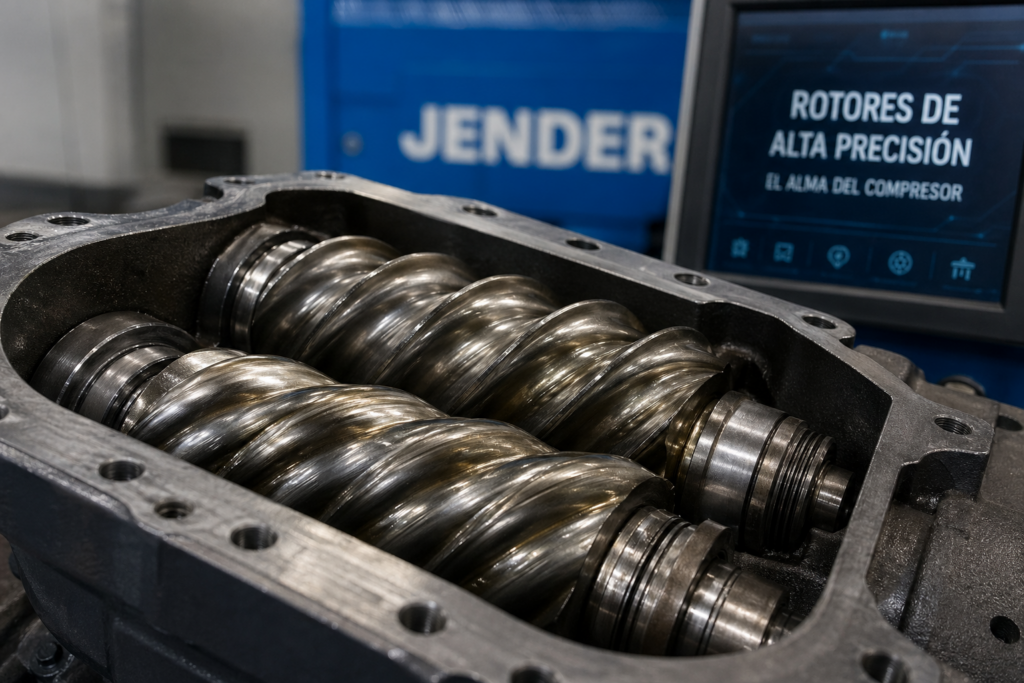
Air-end or compressor unit
The air-end, also known as the compressor unit or compressor block, is the central component of the equipment. Inside are the two helical rotors, the housing that contains them, the bearings that support them, and the seals that prevent internal leaks.
It is the most expensive component of the compressor and the one that determines its service life. It requires no maintenance other than monitoring temperature and noise levels, but its performance depends entirely on the oil and filters being in good condition: virtually all air-end failures originate upstream, from neglected lubrication or filtration.
Inlet Air Filter
It is located before the intake valve, and its job is to retain dust particles, dirt, and contaminants before they enter the air-end. A multi-layer filter can capture particles down to 1 µm. When saturated, the airflow into the compressor is reduced, and the equipment needs to work harder to reach the set pressure, resulting in higher power consumption and a higher discharge temperature.
The clearest sign that it is nearing the end of its service life is the differential pressure gauge: when the pressure difference between the inlet and outlet exceeds the manufacturer’s threshold, it must be replaced. In environments with dust or metal shavings, this interval may be reduced to half the standard value.
This filter protects the compressor, not the system. The air leaving the unit requires its own in-line filtration, and it is important to know which filter is needed at each point in the system based on the air’s end use.
Intake Valve and Load Modulation
The intake valve controls the flow of air into the air-end. When the compressor is operating at full load, the valve is fully open; when demand drops or maximum pressure is reached, it closes partially or completely so that the unit can run down to idle without stopping the motor.
In compressors with variable frequency drives, this modulation is managed by the drive adjusting the motor speed, which eliminates the energy losses associated with idling. This is one of the strongest technical arguments for choosing an inverter-equipped unit in installations with variable demand.
Electric Motor and Transmission System
The motor converts electrical energy into rotational motion to drive the air-end. Modern equipment uses high-efficiency IE3 or IE4 motors, with permanent magnets in some variable-speed models.
Power transmission between the motor and the air-end can be direct, via a beltless coupling, or via a V-belt. Direct coupling eliminates friction losses and reduces maintenance, although its initial cost is higher. In belt drives, incorrect tension is a common cause of premature wear on the air-end’s bearings.
Lubrication System and Oil Circuit
In lubricated screw compressors, the oil performs three functions simultaneously: it seals the space between the rotors to prevent internal leaks, lubricates bearings and moving parts, and absorbs the heat generated during compression. That is why the quality and condition of the oil directly affect the equipment’s performance.
The circuit includes the oil pump, although in some models the differential pressure itself moves the lubricant without an additional pump; the oil filter, which traps metal particles and contaminants; the cooler, which lowers the temperature before the oil is reintroduced into the cycle; and the thermostatic valve, which bypasses the cooler while the equipment has not yet reached its operating temperature. That valve is the reason why a compressor started from a cold state reaches operating speed quickly rather than running for half an hour with oil that is too viscous.
Degraded oil increases internal friction, raises the discharge temperature, and accelerates the wear of bearings and seals. Periodic replacement, generally every 2,000 operating hours or at least once a year, is the maintenance intervention with the greatest impact on the equipment’s service life.
Separator tank and oil-air separator cartridge
After compression, the air-oil mixture enters the separator tank. There, two sequential separation processes take place. The first is mechanical: the mixture begins to rotate, and most of the oil is deposited on the walls by centrifugal force. The second separation is performed by the separator cartridge, which contains a nanofiber medium that induces coalescence: the microdroplets that remain in suspension merge together, gain weight, and fall by gravity to the bottom, from where the recovered oil returns to the lubrication circuit.
A separator in good condition keeps the oil carryover in compressed air below 2–5 ppm. When it becomes saturated, the resulting pressure drop forces the compressor to work harder to reach the setpoint. This is detected by measuring the pressure difference before and after the cartridge: if it exceeds the value specified by the manufacturer, the cartridge must be replaced.
Minimum-pressure valve and safety valves
The minimum pressure valve is located at the outlet of the separator tank and prevents the internal pressure from dropping below about 4 to 4.5 bar. This is not a design quirk: below that threshold, the air flows too quickly through the separator cartridge and carries oil into the system. It also delays the release of air during startup so that the lubrication circuit can pressurize before it begins to deliver flow.
The unit also includes a check valve that prevents air from flowing back from the system into the compressor when it is shut down, and a safety valve set above the maximum working pressure, which vents to the atmosphere if the control fails. The latter is a regulatory safety feature and must not be tampered with or replaced with one set to a different pressure.
Cooling System
Compression generates heat. Without an efficient cooling system, the air discharge temperature can exceed 80-90 °C, which degrades the oil, deteriorates the seals, and can trigger an over-temperature shutdown.
The system includes the oil cooler and the air aftercooler, which lowers the temperature of the compressed air before it exits the unit. In most industrial compressors, cooling is air-cooled, with a fan driven by the same motor or by a separate one. In facilities with high ambient heat loads, where compressor rooms exceed 40 °C, it is common to install forced ventilation or water-cooled systems.
Condensate Drain
When the compressed air cools in the aftercooler, the water vapor carried by the ambient air condenses. That water must be drained from the system, which is the job of the drain valve, located at the lowest point of the circuit.
There are two types. Timed drains open for a few seconds at set intervals, which is simple and inexpensive but expels compressed air every time they activate, even if there is no condensate to discharge. Electronic level-sensing drains detect the presence of liquid and open only when necessary, eliminating that waste. A clogged drain is one of the most common causes of water in the system, leading to pipe corrosion and the resulting deterioration of pneumatic tools.
Control Panel
The electronic controller is the brain of the compressor. It monitors operating pressure, discharge temperature, operating hours, filter status, and active alarms in real time. In modern equipment, it also manages loading and unloading, the speed of the variable-frequency drive, and communication with plant control systems via Modbus, Profibus, or IO-Link.
A screen with an alarm history is the primary diagnostic tool before calling technical service. Most unscheduled shutdowns leave a record that helps identify whether the cause was over-temperature, an oil pressure drop, or a voltage failure.
Bodywork and Sound Insulation
The compressor housing is more than just a casing. Its inner lining of sound-absorbing material is what allows a screw compressor to operate at levels below 70–75 dB and be installed directly in the production area without the need for an additional sound enclosure.
That same bodywork directs the airflow from the fan onto the radiators, so operating with the panels removed not only increases noise but also disrupts cooling and can cause overheating. The air intake and exhaust vents must be kept free of obstructions and free of dust.
Most Common Fault Signs by Component
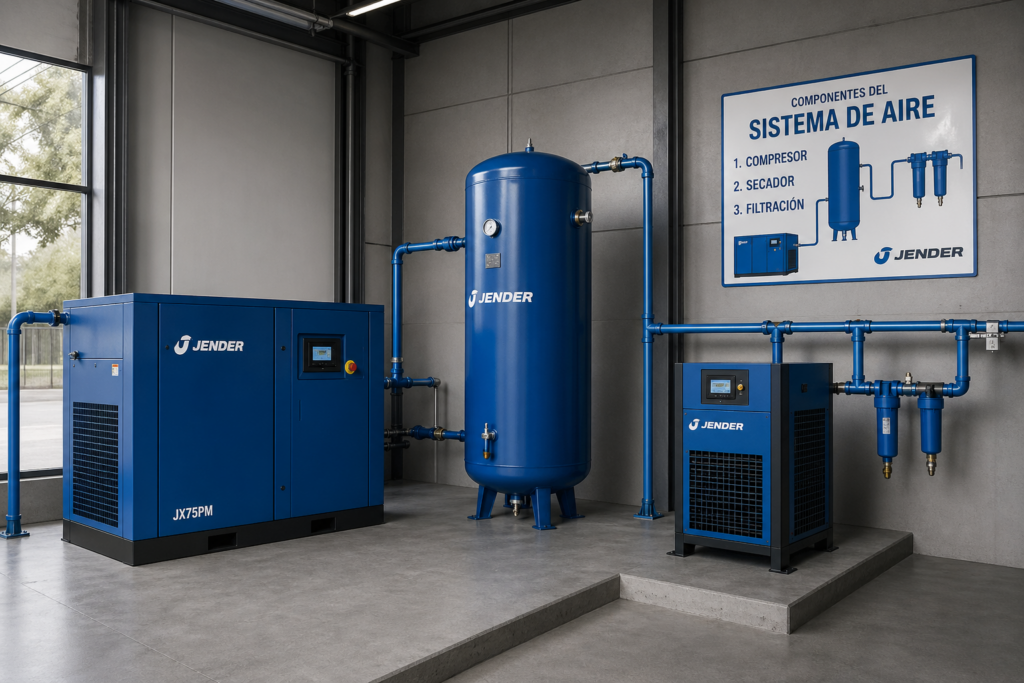
Knowing the parts is only useful if you know what symptom each failure produces. This table lists the most frequent ones in industrial environments:
| Component | Typical Fault Sign |
|---|---|
| Saturated air filter | High power consumption, high discharge temperature |
| Degraded oil or clogged oil filter | Over-temperature, increased consumption, accelerated wear |
| Deteriorated oil-air separator | Oil carryover in the line, abnormally high oil consumption |
| Worn air-end bearings | Unusual noise or vibration, high bearing temperature |
| Intake valve issues | Compressor does not reach set pressure, or does not unload correctly |
| Clogged cooler | Over-temperature shutdown, especially in summer |
| Loose or worn drive belt | Loss of flow, air-end bearing overheating |
| Faulty minimum pressure valve | Oil consumption despite having a new oil separator |
| Thermostatic valve stuck | The unit takes a while to reach operating temperature or is always running cold |
| Clogged condensate drain | Water in the system, corrosion in pipes and tools |
| Clogged body grilles | Overheating with no apparent cause in the oil or radiator |
Preventive maintenance starts with knowing your equipment
A compressor that shuts down during production isn’t just a technical problem: on an industrial production line, the cost of downtime can exceed the entire year’s maintenance budget. Most of the malfunctions on this list show warning signs before causing a shutdown, and almost all of them can be detected by doing two simple things: checking the pressure differential and monitoring the discharge temperature. If you want details on how to diagnose them, we’ve compiled a list of the most common faults and how to resolve them.
At Jender, we manufacture the equipment, so we design it with the maintenance team in mind: direct access to common maintenance points, long-lasting filters, and top-of-the-line components. Our technical support team is available 24 hours a day, 365 days a year, because we know that the most expensive machine is the one that’s not running.
If you’re considering which unit to install, you can check out our units with direct access to maintenance points, ranging from fixed-speed models to direct-drive variable-frequency units with built-in dryers.



