
The service life of an air compressor depends primarily on the type of machine and the use it receives. A piston compressor for workshop use can last between 8 and 15 years; an industrial screw compressor, between 15 and 20 years or more than 80,000 operating hours. The difference lies not only in the technology, but in how it is installed, how it is used, and how frequently it is maintained.
Below you will find actual data by compressor type, which factors shorten that service life prematurely, and what you can do to ensure your equipment reaches the maximum of its cycle.
How Many Years Does an Air Compressor Last?
There is no single figure, but these are the typical ranges according to equipment type and use:
| Compressor type | Estimated service life | Operating hours | Typical use |
|---|---|---|---|
| Single-phase piston (light workshop) | 5–10 years | ~2,000–10,000 h | Intermittent use, low demand |
| Three-phase piston (industrial) | 10–15 years | ~20,000–50,000 h | Regular use with breaks |
| Rotary screw with variable speed drive | 15–20 years | 80,000–100,000 h | Continuous 24/7 operation |
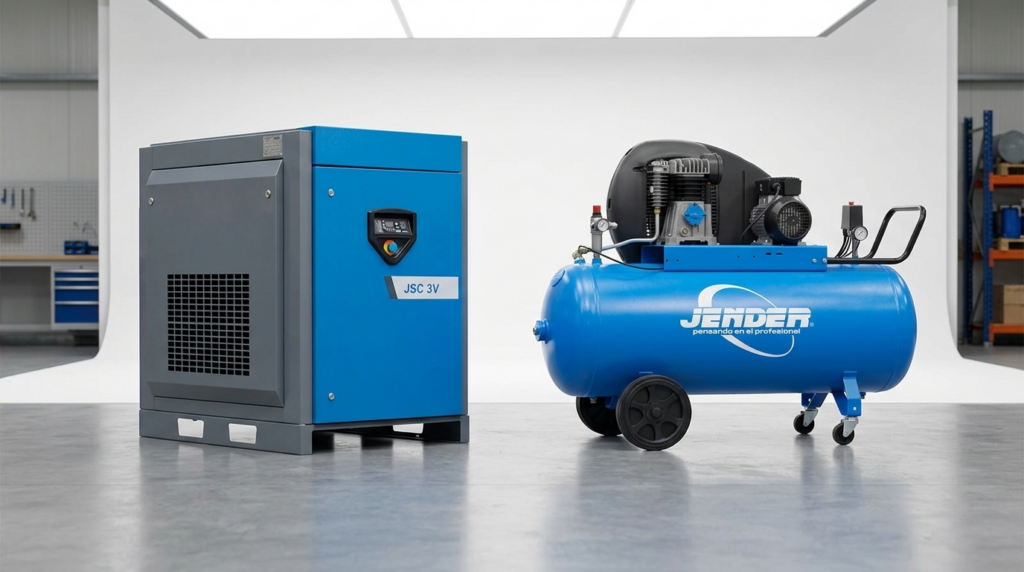
The difference between piston and screw is not arbitrary. The piston compressor works in cycles: it compresses, rests, compresses again. This start-stop cycle generates wear on valves, seals, and crankcase that accumulates over time. Screw compressors are designed to operate at 100% duty cycle continuously, with internal parts that rotate smoothly at low temperature, drastically reducing mechanical wear.
Operating Hours: The Real Measure of Duration
Years are a guideline. The real measure of wear is accumulated operating hours, not the calendar. A compressor that works 2 hours a day ages very slowly even if it is 10 years old. One that operates 16 hours daily can accumulate 40,000 hours in less than 7 years.
Duty cycle also matters. A piston with a 50% duty cycle (operates half the time) requires twice the clock hours to accumulate the same actual compression hours as one working at 100%. If you do not know how many hours your equipment has logged, the hour counter on the control panel is the first place to check; modern screw compressors include it as standard.
What Shortens a Compressor’s Service Life Prematurely
Most compressors that fail before expected do not fail due to manufacturing defects. They fail for one of these reasons:
- Reverse oversizing. Using a small compressor for a demand that exceeds its rated capacity keeps it running almost non-stop, with high temperatures and duty cycles beyond those intended. It accelerates wear on all components.
- Installation in hostile environments. A room with temperatures above 35°C, abrasive airborne dust, or high humidity shortens the life of the filter, oil, and compression element. A compressor that draws in hot air works less efficiently and at higher internal temperature.
- Reactive maintenance. Waiting for a breakdown to occur before taking action is the fastest way to shorten service life. A saturated filter, degraded oil, or a belt with incorrect tension generate damage that accumulates silently for months.
- Inadequate oil. Using motor oil instead of compressor-specific oil completely changes its behavior at temperature. It foams, loses lubricating properties sooner, and carries residues to the air-oil separator.
- Unpurged condensate. In piston compressors, water that accumulates in the receiver tank oxidizes the tank from the inside. In screw compressors, moisture entering through the filter deteriorates the oil and rotors if there is no dryer in the installation.
How to Extend Your Compressor’s Service Life
Three factors have more impact than any other measure: choosing the right equipment from the start, installing it correctly, and maintaining it preventively.
- Choose the right equipment for actual use. An oversized compressor is an unnecessary expense; an undersized one, a constant source of breakdowns. The starting point is to calculate the maximum consumption of the installation with a 20-30% margin over peak demand. For continuous use in production, screw is the natural choice; for intermittent workshop use, piston delivers very good results with lower investment.
- Install under the correct conditions. The compressor room should be kept below 30°C, free of abrasive dust, and have sufficient ventilation so the equipment does not recirculate the hot air it expels. A compressor operating at 25°C ambient temperature performs better and lasts longer than one operating at 40°C, regardless of brand or model.
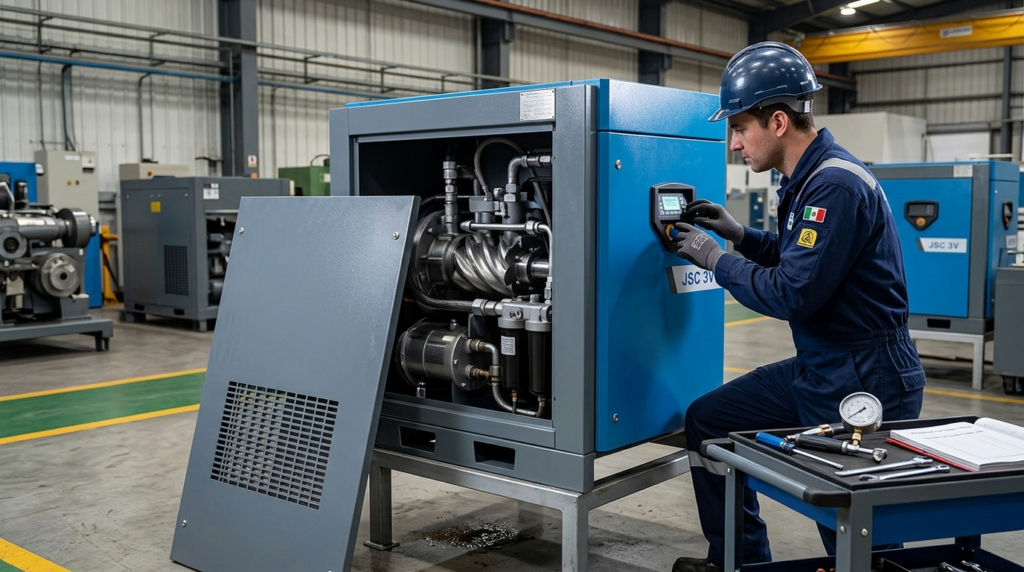
- Maintain preventively. Checking the oil level before each shift, purging the receiver tank daily on piston compressors, changing filters and oil according to the manufacturer’s hours, and inspecting the air-oil separator on screw compressors are tasks that alone prevent 80% of breakdowns. Maintenance is not an expense: it determines whether the equipment reaches 80,000 hours or stops halfway.
When Is It Worth Repairing and When Should You Replace?
The practical rule is simple: if the repair cost exceeds 30-40% of the price of an equivalent new unit, it is worth evaluating replacement. But there are clearer signs than price:
A compressor that stops due to alarms recurrently, has lost flow capacity without apparent cause, or requires repairs every two or three months is no longer economical even if each individual breakdown seems minor. The hidden costs of production downtime, technician time, and emergency parts add up to more than it seems at the moment.
The life cycle of a well-maintained compressor is predictable. A point arrives when the bearings of the compression element, separator, and valves accumulate so many hours that a general overhaul is more cost-effective than replacing parts one by one. Many manufacturers establish that overhaul point between 40,000 and 60,000 hours for screw compressors. Beyond that, the decision depends on the actual condition of the equipment and whether the technology available on the market provides a significant energy efficiency improvement versus the cost of new equipment.
Compressors Built to Last by Jender
At Jender we manufacture piston and screw compressors, which allows us to know both types of equipment inside out and provide unbiased advice on which fits best with each installation. Our technical service operates 24 hours a day, 365 days a year throughout Spain, because we know that on a production line, downtime matters more than any other variable.
If your installation operates continuously and you are looking for equipment with an actual service life of more than 15 years, consult our range of professional piston compressors for workshop and industry, or contact us so a technician can evaluate which equipment best fits your actual demand.



