
Air compressors are divided into two main families based on the principle by which they compress air: positive displacement, which traps a quantity of air and reduces its volume to increase pressure, and dynamic, which accelerates air to high speeds and then slows it down to convert that kinetic energy into pressure. The first family is the most widespread in workshops and industry; the second appears in very large-scale applications.
Within each family, there are several types with different characteristics and applications. This article covers the most relevant ones, explains what differentiates them, and provides guidance on when it makes sense to choose each one.
Positive displacement air compressors
These are the most common compressors in any professional or industrial environment. Their operating principle is always the same: a chamber traps air at atmospheric pressure, reduces its volume mechanically, and expels it at a higher pressure. What varies between types is the mechanism that performs this volume reduction.
Piston air compressor
This is the oldest and most widespread technology. A piston moves back and forth within a cylinder: as it moves down, it draws in air, and as it moves up, it compresses it. It is robust, economical, and easy to maintain, making it the standard choice for small workshops, professional DIY, and applications with intermittent air demand.
Its main limitation is that it is not designed to run continuously: it requires periodic stops to dissipate the heat generated during compression. This makes it less suitable for facilities where the compressor works many consecutive hours a day. At Jender, the range of piston air compressors spans from compact DIY models to two-stage units with 500-liter tanks for intensive industrial use.
Screw air compressor
This is the reference technology in industrial environments with continuous air demand. Two helical rotors rotate in synchronization, trapping and compressing air progressively and continuously, without pulsations. It can operate 24 hours a day without stopping, with significantly lower noise levels than piston compressors and less internal wear over time.
It is more expensive to acquire than a piston compressor, but its long-term operating cost is lower with intensive use. Models with a frequency inverter adapt motor consumption to the actual air demand at all times, offering energy savings of up to 35% compared to fixed-speed equipment. Jender’s screw air compressors cover from 3 to 315 kW with options for variable speed, direct drive, and integrated dryer.
Vane air compressor
It uses an eccentric rotor with sliding vanes that create chambers of decreasing volume as they rotate. It produces a fairly continuous flow with few pulsations and is compact for its flow rate. It is used in applications where air is needed at moderate pressures and space is limited, although its use in general industrial environments has been losing ground to screw compressors for reasons of efficiency and maintenance.
Scroll air compressor
It uses two interleaved spirals, one fixed and one mobile, which compress the air progressively by reducing the chambers formed between them. It produces a very smooth and quiet flow, and in its oil-free version, it offers high-purity air without the need for additional filtration.
This is the standard technology for medical applications, laboratories, electronics, and environments where noise and air purity are critical. Its flow rate is limited compared to high-power screw or piston compressors, making it less suitable for high industrial demands.
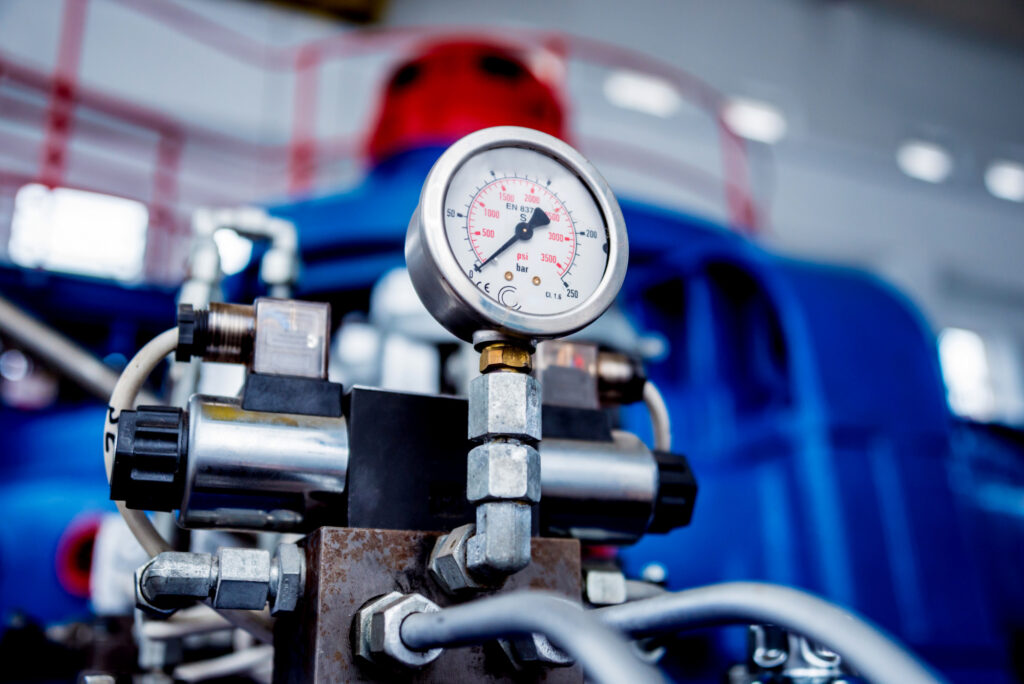
Dynamic air compressors: for large industries
Dynamic compressors do not reduce the volume of air but rather accelerate it using a high-speed rotating impeller and then slow it down in a diffuser to convert kinetic energy into pressure. The most common is the centrifugal compressor.
They work at constant pressure with very high flow rates, making them suitable for large industrial facilities: chemical plants, petrochemicals, power generation, or large-scale industrial gas production. They are large-sized units with high costs and are practically never seen in workshops or small and medium-sized enterprise facilities. There is also the axial variant, where air flows parallel to the rotor axis, common in gas turbines and aircraft propulsion.
For the user looking for compressed air for a workshop or general industry, dynamic compressors are not a practical option. Their territory is large plants with consumption levels far exceeding what any conventional piston or screw compressor can cover.
When is each type of air compressor used?
Each technology has a clear usage profile, and knowing it beforehand avoids selection errors:
- Piston compressor: intermittent use in small workshops, professional DIY, carpentry, tire inflation, occasional painting, and applications where the compressor does not need to run for more than a few hours a day.
- Screw compressor: continuous use in general industry, automotive, manufacturing, food, and any facility where the compressor is part of the production process and operates many hours daily without interruptions.
- Vane compressor: applications requiring continuous flow at moderate pressures in confined spaces, such as small industrial facilities or light vacuum equipment.
- Scroll compressor: environments where air purity and noise levels are critical: dental clinics, laboratories, electronics, medical applications, and pharmaceutical processes.
Oil-lubricated or oil-free air compressors
Regardless of the type of compressor, almost all are available in oil-lubricated and oil-free versions. This distinction affects the quality of the air produced and is as relevant as the type of technology when choosing.
Lubricated models inject oil into the compression chamber to seal, cool, and lubricate. The resulting air may carry oil traces that line filters reduce to acceptable levels for most industrial and workshop applications. They are more economical and robust.
Oil-free models do not introduce any lubricant into the compression chamber. The air produced has a certified purity according to ISO 8573-1 standards, necessary in sectors such as food, pharmaceuticals, electronics, or medical applications. Their acquisition cost is higher, but in these environments, there is no valid alternative.
How to navigate such a wide variety of compressors
With so many options available, the key is to always start with the actual use rather than the technical characteristics of the equipment. How many hours a day the compressor will run, what flow rate and pressure you need, whether the air must be oil-free, and how much space you have available are the questions that narrow down the range of options to the two or three that truly fit your case.
It is also worth knowing that air compressors can be damaged when used outside their design conditions, whether due to oversizing, undersizing, or failing to respect recommended duty cycles. Choosing correctly from the start is the best way to avoid premature breakdowns and unnecessary costs.
At Jender, we help you choose the type of compressor you need
At Jender, we have been manufacturing air compressors for workshops, installers, and industrial companies for over two decades. We know each type of equipment from its design, which allows us to guide you with real expertise toward the most suitable solution for your facility, without intermediaries and with free technical advice.
If you have doubts about which type of compressor best fits your case, contact our team before making any decision.



