
A screw compressor is a positive displacement machine that compresses air through the synchronized rotation of two helical rotors, one male and one female, housed in a casing. Air enters through the intake, becomes trapped between the screws and the wall, and as the rotors turn, the available volume is reduced until the air exits compressed through the discharge port.
It is the most widely used type of compressor in industrial environments with continuous air demand. If you are evaluating whether this equipment fits your installation, in this article you will find how it works internally, the differences between the available types, and the specific criteria to know if it is what you need. If you wish to view the available models directly, you can consult our range of screw air compressors.
How a screw compressor works internally
The operating principle is positive displacement: volume is reduced to increase pressure, without the need for valves or pistons.
When the compressor starts, a suction valve allows air to enter the compression element, where the two helical rotors are located. The male rotor has convex lobes; the female, concave cavities. They rotate synchronized in opposite directions without touching. The air is trapped in the cavities formed between them, and as the screws rotate, that space is progressively reduced.
When the air reaches the pressure set by the discharge port, it exits toward the tank or directly into the network. The cycle is continuous, without pulsations, which explains why rotary screw compressors can work at 100% of the duty cycle without needing stops to cool down.
Unlike a piston compressor, there are no mechanical imbalance forces, which translates into fewer vibrations, less noise, and structurally lower wear over time.
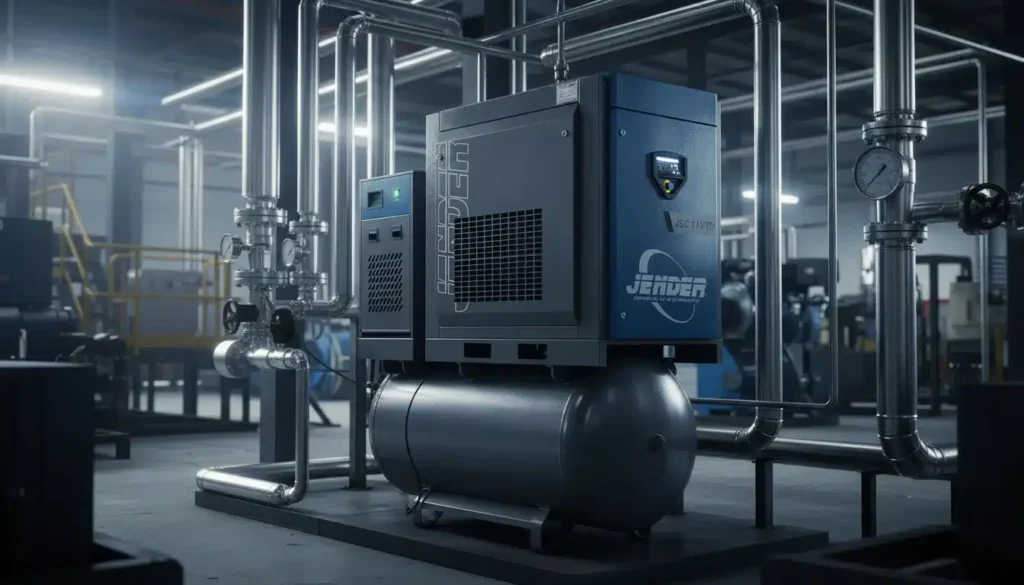
Oil-lubricated or oil-free screw compressor: which one suits you
This is one of the first decisions to be made, and it depends on the final use of the air.
In oil-lubricated models, oil is injected into the compression chamber to seal the clearances between rotors, cool the element, and lubricate the bearings. The oil is recovered and filtered in a separator before the air enters the network. These are the most common in general industry, automotive, woodworking, or manufacturing, where a small residual trace of oil in the air (which filters remove) does not compromise the process.
Oil-free compressors do not introduce any lubricant into the compression chamber. The rotors work with special coatings and more demanding cooling systems. They are necessary in sectors where air purity is critical: food, pharmaceuticals, electronics, or medical applications. The purchase cost is higher and they require greater precision in manufacturing, but they guarantee that the air produced does not carry any contaminants derived from the lubricant.
If your process does not require certified air purity, oil-lubricated models offer a much higher cost-performance ratio. That said, within each category there are variants with relevant differences in transmission, cooling, and configuration, and knowing the types of screw compressors available will help you refine your choice before purchasing.
Real advantages over other compressors
Screw compressors have specific and well-documented advantages, but also conditions of use in which they are not the most efficient choice. It is advisable to have both perspectives clear.
What they do well:
- Continuous and stable air flow: without pulsations or interruptions, which is decisive in processes requiring constant pressure.
- 100% duty cycle: they can operate uninterruptedly without risk of overheating.
- Low noise level: usually below 70-75 dB, allowing them to be installed in the workshop or production area itself without additional insulation.
- Long service life: as they have no valves or pistons subject to mechanical fatigue, internal wear is significantly lower than in a reciprocating compressor.
- Energy efficiency in intensive use: especially in models with a variable speed drive (VSD), which adapt consumption to the actual flow demanded at any given time.
What to keep in mind:
The initial investment cost of a screw compressor is higher than that of a piston compressor of similar power. Furthermore, its maintenance, although infrequent, requires specialized technicians and specific spare parts. If air use in your facility is intermittent—that is, a few hours a day or with widely spaced peaks—the economic equation may not favor the screw compressor.
When to choose a screw compressor and when not to
This is the question that few articles answer clearly. Screw technology makes sense when:
- The compressor will operate for more than 4-6 hours daily on a sustained basis.
- The installation needs constant flow without interruptions (production lines, pneumatic robots, industrial painting systems).
- The noise level is a limiting factor due to proximity to workstations.
- The goal is to reduce energy consumption in the long term and make the investment profitable over time.
- The application requires certified clean air (in which case, an oil-free screw compressor).
On the other hand, if use is intermittent, the initial investment must be contained, or the pressure and flow requirements are moderate, a piston compressor is a more suitable alternative. This is the case for small workshops, professional DIY applications, or inflation points.
There is no universally superior technology: there is the most suitable technology for each usage profile.
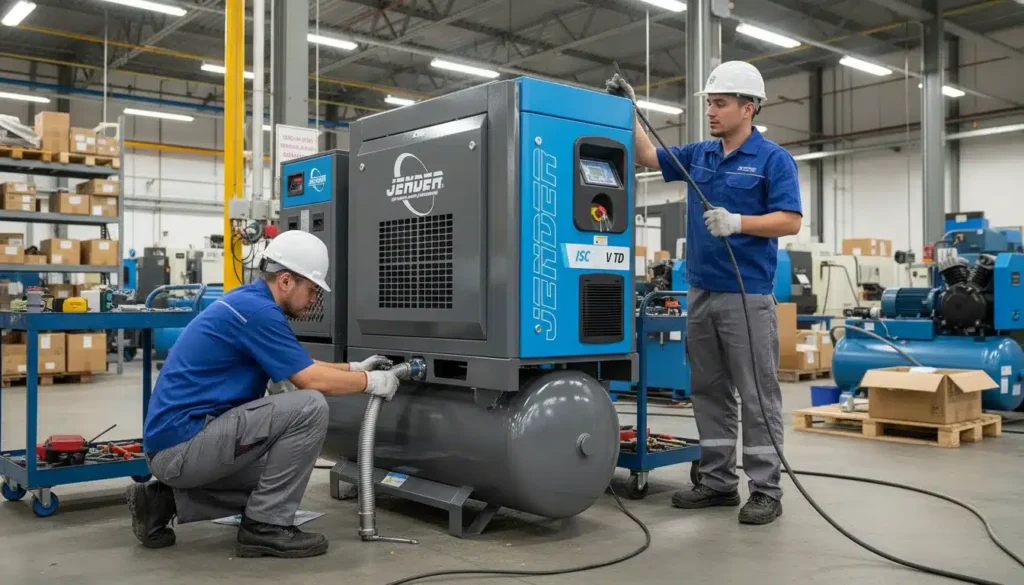
What to look for before buying a screw compressor
Beyond power in kW, there are several parameters that determine if a unit is well-suited to your installation:
Free Air Delivery (FAD): expressed in m³/min or l/min, it indicates the actual amount of air the compressor delivers to the network. This is the most important data for sizing the equipment according to the consumption of your tools or machinery.
Working pressure in bar: most industrial installations work between 7 and 10 bar. The screw compressors in Jender’s JSC range cover 7.5, 10, and 13 bar to adapt to different requirements.
With or without integrated dryer: compressed air carries moisture, and this moisture can damage tools, clog pipes, or contaminate the process. Opting for a compressor with an integrated refrigerant dryer simplifies the installation and guarantees air quality in the network from the start.
Power and duty cycle: an oversized compressor starts and stops constantly in short cycles, which accelerates wear. An undersized one works at its limit. Correct sizing is as important as the choice of technology.
Direct drive vs. belt drive: direct drive models eliminate the need to tension and replace belts, have lower consumption, and require fewer preventive maintenance interventions.
Jender: compressor manufacturer with more than 20 years of experience
At Jender, we have been manufacturing air compressors for installers, industrial companies, and end users for more than two decades. We know the equipment inside out because we design and manufacture it ourselves, allowing us to offer prices without intermediaries and real technical advice based on our own experience.
Our range of screw air compressors includes models from 3 kW to 315 kW, with fixed speed and variable speed (VSD) options, tank mounting, with or without an integrated dryer, and working pressures of 7.5, 10, and 13 bar. Each unit is customizable according to the specific needs of the installation.
If you have doubts about which equipment best fits your actual consumption, our technical team will advise you at no cost to help you make the right decision before investing.



