
Piston compressors are divided into two main groups depending on the intended usage profile: the DIY range and the professional range. At Jender, we clearly distinguish between these two types because they meet very different needs, and choosing the wrong equipment has a real cost—either because it falls short in performance or because you overinvest in equipment you will not fully use.
DIY models are compact, portable units designed for home use and occasional jobs; professional models are higher-power, higher-capacity machines designed for workshops and industry, with one- and two-stage variants depending on the demands of the job. Understanding what defines each type and what situations it is designed for is the first step toward choosing your ideal piston compressor.
DIY piston compressor: compact, portable, and easy to use
The DIY piston compressor is the most accessible option in the range, both in price and ease of use. Its coaxial design integrates the motor and pump head into a compact assembly mounted directly on a small-volume tank, resulting in a lightweight unit that is easy to transport and does not require fixed installation.
With power around 1.5 kW and tanks between 24 and 50 liters, it is designed for occasional tasks that do not require a continuous air supply: inflating tires, powering blow guns, light staplers, or paint spray guns for small surfaces. The maximum working pressure is 8 bar, sufficient for most of these applications.
Its main limitation is the duty cycle. Like all piston compressors, it is not designed to run continuously, and in the most compact models this limitation is more pronounced. They are units for occasional, intermittent use, not for long shifts or powering several tools at once.
It is the right option for anyone who needs a compressor occasionally, wants to move it easily from one place to another, and does not need high flow rates or high pressures. If your main use is in a workshop or industry, this range will quickly fall short.
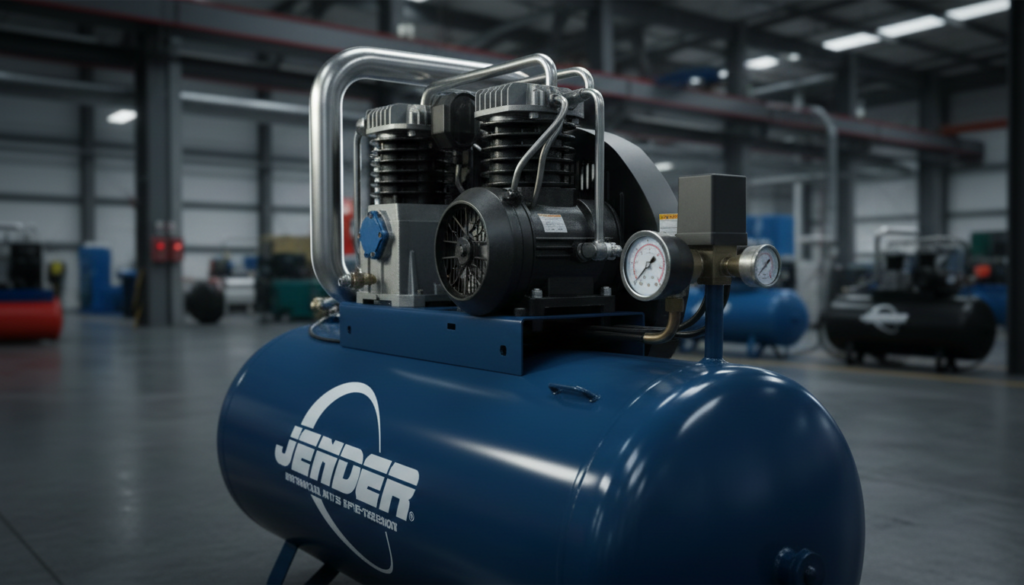
Professional-use piston compressor: for workshops and industry
The professional range represents a qualitative leap over the DIY range in all relevant parameters: power, tank capacity, maximum pressure, and build robustness. It is designed for intensive use in mechanical workshops, carpentry, body shops, industrial facilities, and any environment where the compressor is part of daily work.
Within this range, there are two main variants depending on the number of compression stages:
Single-stage piston compressor
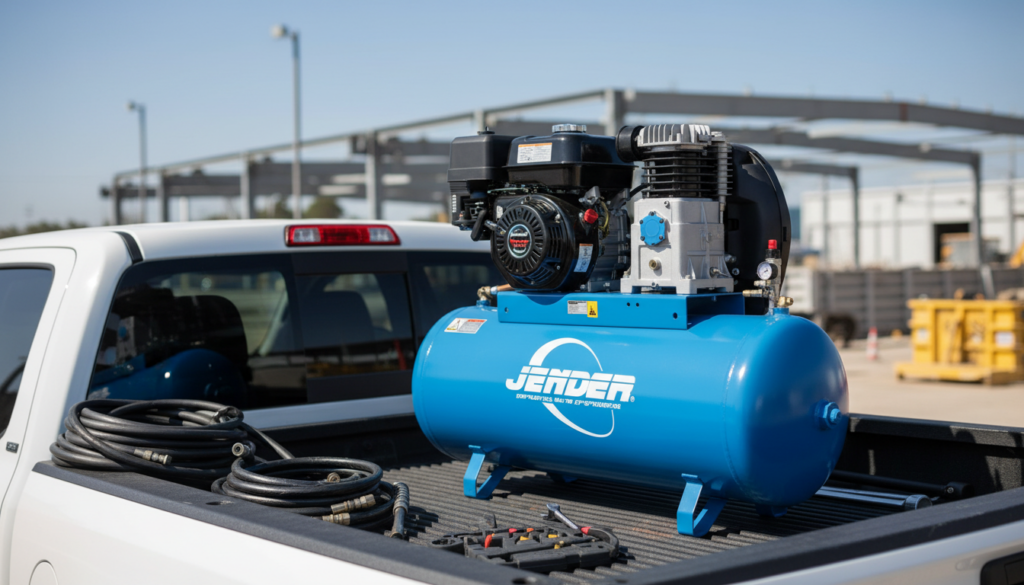
The single-stage professional piston compressor compresses air in a single step up to the working pressure. With power between 1.5 and 2.2 kW, 100- and 200-liter tanks, and a maximum pressure of 10 bar, it is the standard unit for most professional workshops with moderate demand.
It can efficiently power impact wrenches, paint spray guns, pneumatic drills, blow guns, and other common workshop tools. Its rotational speed of between 1,075 and 1,350 rpm gives it a performance coefficient of 0.75, meaning it makes better use of the intake air than faster models and generates less heat during operation.
It is available in single-phase (230 V) configuration for workshops with domestic-type electrical installations, and three-phase (400 V) for industrial installations. It is the most balanced option in terms of performance, initial investment, and ease of maintenance for most professionals.
Two-stage piston compressor
The two-stage piston compressor compresses air in two consecutive phases with intermediate cooling, allowing pressures of up to 11 bar with greater efficiency and lower discharge temperatures. With power between 3 and 7.5 kW and tanks from 270 to 500 liters, it is designed for more intensive industrial use where higher available flow and longer duty cycles are required.
It is the right option when the installation needs to power several tools simultaneously, air consumption is high, or the connected tools require high flow rates, such as sandblasters, industrial grinders, or large impact wrenches. Higher-power models include a star-delta starter to manage motor start-up in three-phase installations.
With the same tank volume, the two-stage model delivers more usable air at higher pressure than the single-stage model, although its purchase price and dimensions are also greater.
Single-phase or three-phase compressor: which power supply do you need?
The electrical power supply is a factor that determines which models are viable in each installation, and it is advisable to be clear about it before choosing.
Single-phase compressors operate at 230 V and can be connected to any standard domestic or industrial socket. They are the usual option in small workshops, garages, and spaces without an industrial electrical installation. The DIY range and the lower-power professional models are all single-phase.
Three-phase compressors require a 400 V three-phase installation. They are the standard in workshops and industrial plants because they allow higher-power motors with smoother starting and more efficient consumption. Above a certain power level, three-phase is not an option but a technical necessity. All two-stage professional models in the Jender range are three-phase.
How do you know which type of piston compressor you need?
The right choice depends on three specific questions: how many hours a day the compressor will run, which tools it will power, and whether the use is occasional or part of daily work.
For occasional use at home or in the garage, the DIY range perfectly covers the needs with minimal investment. For a professional workshop with daily use and one or two tools running simultaneously, the single-stage model with a 100- or 200-liter tank is the most balanced solution. For installations with higher demand, several connected tools, or more demanding work such as industrial painting or sandblasting, the two-stage model with a 270- to 500-liter tank is the appropriate answer.
A practical criterion that helps you decide: no piston compressor should operate continuously at 100% of its capacity. If your actual consumption is close to or exceeds the limit of the unit you are considering, moving up to the next level in the range is always the best investment.
The piston compressor you are looking for is at Jender
At Jender, we manufacture piston compressors for all usage profiles, from the most compact DIY range to two-stage industrial models with 500-liter tanks. All our equipment is manufactured with components that meet international standards and includes CE and TÜV Austria certifications, among others.
As direct manufacturers, we offer European manufacturing quality at prices without intermediaries, with free technical advice to help you choose the model you truly need. You can view the full range and buy piston compressors directly in our store.



