
Correctly sizing the compressed air network is the difference between an installation that performs and one that causes breakdowns and extra costs from the very first month. It is one of the most common mistakes in an industrial compressed air installation, whether by undersizing or oversizing, and it directly affects pressure, flow rate, power consumption, and the compressor’s service life.
In this article, we cover the real problems caused by poor sizing, the most frequent design mistakes, and the criteria you need to follow to design an efficient network.
Problems with an undersized compressed air installation
When the network is not sized to meet the actual air demand, the system fails in a chain reaction. Pipes that are too small cause pressure drops that reduce the performance of pneumatic tools and drag down plant productivity. Added to that pressure drop is an obvious lack of flow: the system does not deliver the required air volume, slows processes, and ultimately causes production stoppages.
The compressor pays the price. Insufficient flow forces the screw or piston compressor to operate beyond its capacity, resulting in overheating, recurring breakdowns, and a significant reduction in service life. And all of this comes with runaway energy consumption, because constant starts and stops drive up electricity use and undermine the system’s overall efficiency.
Problems with an oversized installation
Going too far is not the solution either. Oversizing a compressed air network creates inefficiencies and unnecessary costs from day one. The initial investment increases without justification: installing larger pipes and equipment means a higher cost to deliver exactly the same pressure and flow as a properly calculated installation.
On top of that comes energy waste, as an oversized compressor consumes more energy than necessary and increases operating costs month after month. And a less obvious but very damaging problem appears: pipes that are too large reduce air velocity, encourage water accumulation, and increase the risk of corrosion and condensation.
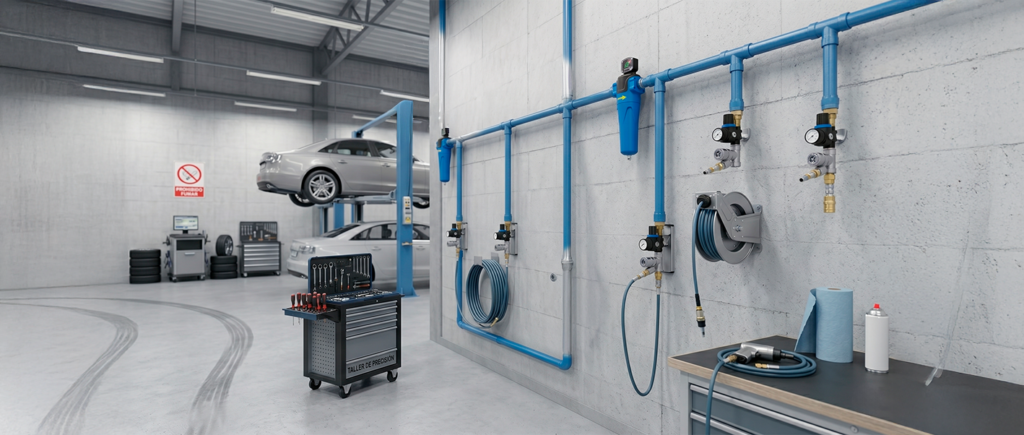
Common mistakes in installation design
Beyond sizing, there are design mistakes that directly penalize network performance. The most widespread is leaks: a poorly designed installation can cause air losses of between 20% and 30%, an enormous energy waste. Every elbow, every drop, and every manifold is an obstacle to pressure and a potential point of breakage or leakage, or over time, a safety risk.
Air quality also suffers. The absence of adequate filtration systems allows water, oil, and particles to reach the tools, contaminating processes and damaging equipment. And the lack of automatic drains causes condensate build-up that ends up corroding the pipes and progressively degrading the installation.
How to design an efficient compressed air network
To avoid these problems, the design must be based on measured variables, not estimates. The minimum criteria to consider are:
- Required flow rate, calculated based on the installation’s actual consumption
- Required working pressure
- Network design, preferably a ring main
- Pipe length and diameter
- Filtration and drying systems
- Compressor and receiver tank capacity
Benefits of a properly sized installation
A network sized with sound criteria reduces energy consumption, extends equipment service life, and improves plant productivity. Breakdowns are kept to a minimum and air quality is guaranteed at all points of use. In practice, a well-designed installation pays for itself in just a few months through everything it stops costing you.
Entrust the sizing of your compressed air network to Jender
At Jender, we are manufacturers and specialists in industrial compressed air installations, with nationwide technical service in Spain available 24 hours a day, 365 days a year. Our objective is clear: to ensure your installation does not stop, and if it does, to get it back up and running in the shortest possible time.
We support you at every stage of the process: system design and sizing, installation and commissioning, maintenance, repair, and energy optimisation. Request advice at www.jender.es and design a compressed air network that performs from day one.



