
Compressed air is one of the most widely used sources of energy in industry: it is estimated that up to 70% of factories use it at some point in their production process, to the extent that it is considered the fourth basic utility after electricity, water, and gas. Its success stems from a combination of factors that is hard to match: it is safe, versatile, easy to store and control, and allows energy to be transferred to a wide variety of workstations using a single central system.
However, that versatility comes at a cost that many plants discover too late: compressed air is also one of the factory’s biggest consumers of electricity. Understanding where it’s used, what quality each process requires, and how it performs in terms of energy efficiency is the difference between a system that drives production and one that eats into profit margins. In this guide, we review the applications of compressed air in industry, the sectors where it is critical, its advantages over other energy sources, and the keys to making it cost-effective.
What Is Compressed Air Used For in Industry?
Compressed air applications span virtually the entire production chain, from raw materials to the finished product. Although every factory has its own unique characteristics, most uses fall into four broad categories.
The first, and most widespread, is automation and pneumatics. Air powers cylinders, valves, actuators, and robotic arms that move and control assembly lines. It is the energy that drives the automated systems: opening and closing, pushing, gripping, and positioning. In a modern factory, many repetitive movements are handled using compressed air because it is fast, clean, and does not generate sparks.
The second segment is manufacturing and processing, where air is an integral part of the production process itself, rather than merely a feedstock. This includes mixing substances, rapidly cooling parts, blowing in plastic and glass manufacturing, and separating gases to obtain nitrogen or oxygen. In these cases, air ceases to be a mere driving force and becomes an ingredient in the process.
The third section covers tools and finishing. Compressed air powers pneumatic tools such as screwdrivers, drills, sanders, and impact wrenches, as well as painting and coating application equipment. When painting, a stable pressure ensures a uniform, flawless finish.
The room combines cleaning, blowing, and conveying. The air removes dust, chips, and debris from parts, molds, and equipment; dries surfaces after washing; and conveys powdered or granular materials along the line via pneumatic conveying, eliminating the need for manual handling.
Compressed Air by Industrial Sector
The physical principle is always the same, but each industry applies it in its own way and, above all, requires a different level of air quality. The air that moves a press in a metalworking shop is not the same as the air that blows into a bottle before it is filled with juice. This table summarizes the most common applications and requirements by industry:
| Sector | Main Applications | Air Quality Standards |
|---|---|---|
| Automotive | Impact tools, robotic arms, paint booths | High (the paint must be dry and oil-free) |
| Food and beverages | Packaging, blow molding, ingredient transport | Very high (direct or indirect contact with food) |
| Metalworking and Carpentry | Machining centers, laser cutting, presses | Media (prioritizes stable flow and pressure) |
| Textile and Graphic Arts | Pneumatic looms, high-speed printing | High (dry, clean air to prevent staining) |
| Electronics | Precision assembly, component cleaning | Very high (no particles or moisture) |
| Pharmaceutical | Packaging, laboratory processes | Critical (air free of oil and microorganisms) |
As a general rule, the more critical the process and the closer the air is to the final product, the higher the purity required. This factor determines the entire design of the treatment system.
Air as a source of energy and air as part of the process
A clear way to understand the different requirements is to distinguish between two uses of air. When air is used solely as a driving force (to move a cylinder or operate a valve), it acts as pure energy, and its purity requirements are moderate: it simply needs to be reasonably dry and clean so as not to damage the pneumatic components.
The situation changes completely when air comes into contact—directly or indirectly—with the product. Whether blowing into a container, transporting powdered food, or drying a freshly washed item, any traces of oil, water, or particles can end up in the final product. In these cases, requirements become much more stringent, and oil-free compressors and high-efficiency filtration systems are used. Identifying which category each consumption point in the plant falls into is the first step in sizing the treatment system correctly—ensuring you neither under-size it nor overpay.
Advantages of Compressed Air Over Other Energy Sources
The widespread use of compressed air is no coincidence. Compared to direct electrical or hydraulic power, it offers specific advantages in industrial settings. It is safe in environments where an electrical spark would pose a risk, because it generates neither static electricity nor heat at the point of use. It is clean, since an air leak does not cause pollution the way a hydraulic oil leak would. It can be easily stored in tanks, which allows for the absorption of demand spikes. And it is flexible: a single compressor can power dozens of very different tools and machines through a single network.
Its main drawback is energy efficiency: converting electricity into compressed air and then that air into work results in energy losses. Therefore, even though it is convenient and safe, it should be used judiciously, and its consumption should be closely monitored—which is exactly what we’ll look at next.
Energy Efficiency: The Hidden Cost of Compressed Air
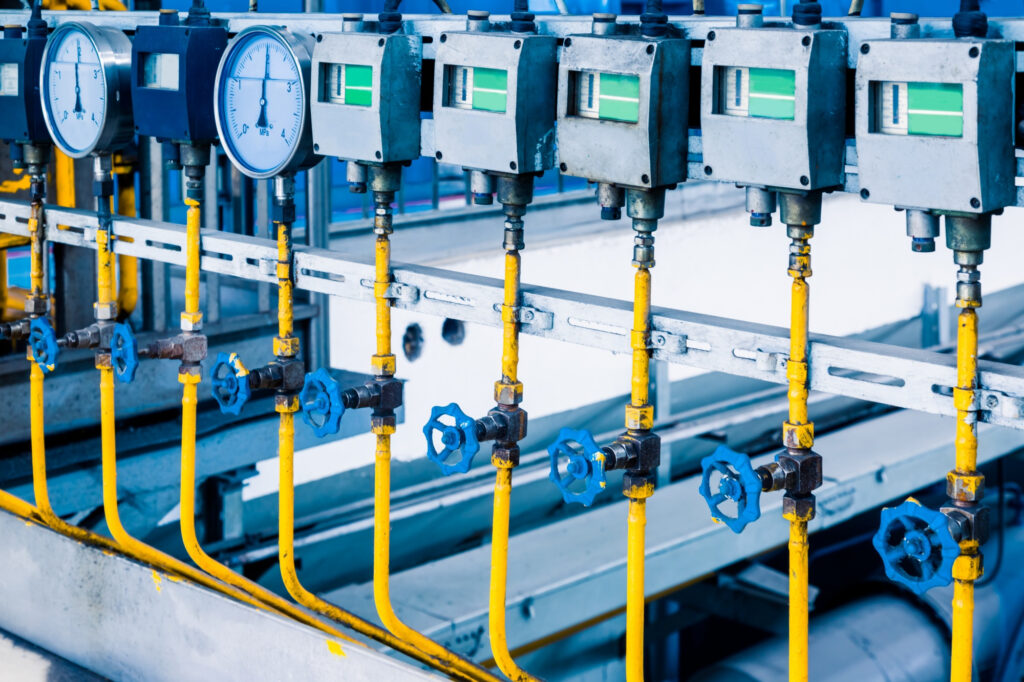
Compressed air has a reputation for being expensive, and for good reason: compressed air systems can account for between 5% and 10% of an industrial plant’s total electricity consumption. The cost of purchasing the compressor is only a small fraction of the total expense over its useful life; what really weighs on the bottom line is the electricity bill for generating air month after month, year after year.
The good news is that this consumption can be significantly reduced—without major investments. The three most important factors are controlling leaks (a poorly maintained system can lose between 20% and 30% of the air it produces), adjusting the operating pressure to the actual level needed, and keeping the filters clean so the compressor doesn’t have to work harder than necessary. Added to this is the technology of the equipment itself: variable-speed screw compressors adapt power consumption to the actual demand at any given moment and eliminate costly no-load starts—a savings you’ll notice from the very first month. We cover this in detail in our solutions for industry.
What Does an Industrial Compressed Air System Consist Of?
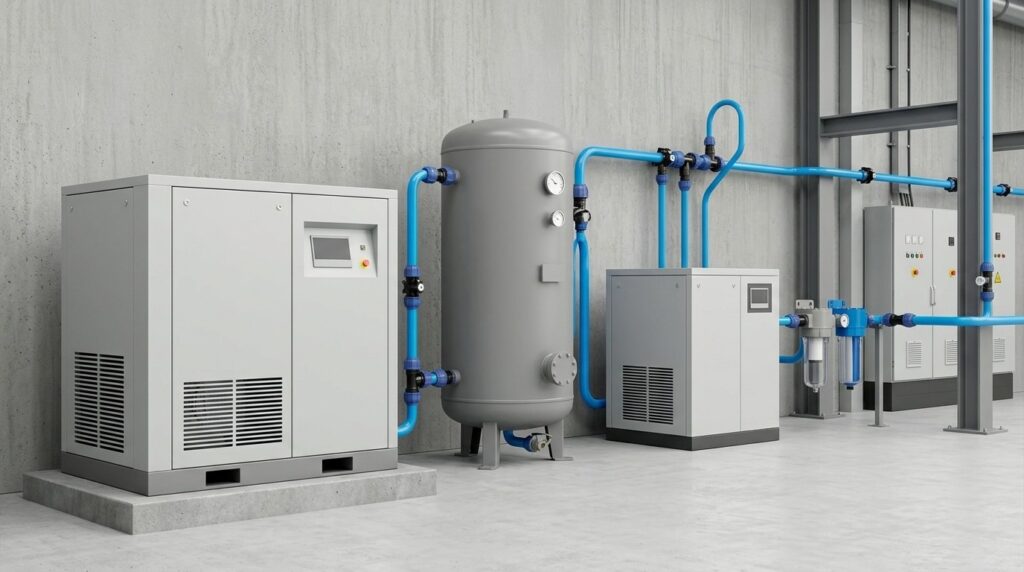
A compressed air system is not just the compressor, even though it is the heart of the system. It is a chain of components that work together, and the performance of the entire system depends on its weakest link. The compression unit (screw-type for high continuous flow rates, piston-type for more intermittent uses) generates the compressed air. A receiver tank stores and stabilizes it, absorbing peaks in demand. The treatment system (filters, dryers, and purge valves) removes moisture, oil, and particles to the level required by each process. And the distribution network carries the air from the compressor room to each point of use.
That system, typically constructed from aluminum tubing due to its corrosion resistance and low internal friction, is just as critical as the compressor itself. A poorly sized system, with poorly designed bends or leaks, causes pressure drops that force the compressor to work harder and undermine the efficiency of the entire system. Properly designing the compressed air system ensures that energy reaches the machinery in a stable manner and without losses.
Safety in the Use of Compressed Air
Although it is a safe form of energy, compressed air is not without risks, and it is important to be aware of them. Built-up pressure can cause accidents if mishandled: never direct a stream of air toward the skin or eyes, nor use it to clean clothing or the body, as this can cause air to enter the body or propel particles at high speed. Pressurized tanks and equipment are governed by specific regulations and require periodic inspections. Training staff on proper use and maintaining the system in good condition are the best preventive measures.
Jender, your industrial compressed air supplier
At Jender, we design, install, and maintain compressed air systems for industry: variable-speed screw compressors, aluminum distribution networks, and air treatment equipment—all designed to ensure that every cubic meter of air costs as little as possible and is delivered in the condition your process requires. With in-house engineering, direct sales with no middlemen, and technical service throughout Spain 365 days a year, our priority is to keep your production running—and if something goes wrong, to get it back up and running as quickly as possible. Tell us about your plant, and we’ll prepare a customized proposal for you.



