
A compressed air dryer is a piece of equipment that removes moisture from the air produced by a compressor, preventing condensed water from damaging the system, tools, and the final product. When air is compressed, the water vapor it contains becomes more concentrated, and as it cools in the system, it turns into liquid water. The dryer removes this moisture before it reaches the points of use. Together with filters, it is a key component of compressed air treatment.
Without a proper dryer, that water causes corrosion in the pipes, damage to pneumatic components, frozen lines in the winter, and—in industries such as food and pharmaceuticals—direct contamination of the product. In this guide, you’ll learn how a dryer works, what types are available, and which one is best suited for each installation.
Why does compressed air contain water?
Atmospheric air always contains water vapor. When compressed, that vapor is concentrated into a much smaller volume, and when the air cools as it circulates through the system, the vapor condenses and liquid water forms. The more humid the environment and the hotter the day, the greater the amount of water the compressor generates, which is why condensation problems skyrocket during the hot months. The parameter that measures how dry the air is is the dew point: the lower it is, the drier the air.
How does a compressed air dryer work?
The general principle is to force the water to condense in a controlled manner within the dehumidifier itself, so that it can be drained before it reaches the system. The method for achieving this varies depending on the type of dryer: the most common ones cool the air so that the water condenses and is separated, while others use materials that absorb moisture. In all cases, the goal is the same: to deliver air to the system with a dew point low enough to prevent liquid water from forming downstream.
Types of Compressed Air Dryers
There are several types, but two of them account for the majority of industrial facilities.
Refrigerated dryer. It is the most widely used type. It cools the compressed air to about 3 °C so that water vapor condenses and is separated, and then reheats it. It meets the needs of the vast majority of industrial applications; it is economical and low-maintenance. Its typical dew point is around +3 °C, which is sufficient for workshops, the automotive industry, woodworking, and general-purpose uses.
Adsorption dryer. It uses a desiccant material that traps moisture from the air. It achieves much lower dew points (down to -40 °C or -70 °C), which are necessary in critical applications such as the pharmaceutical, electronics, and food industries, as well as in outdoor processes where the air can freeze. It is more expensive and consumes more energy, but it is the only option when extremely dry air is required.
There are also membrane dryers and other systems for specific applications, but for most installations, the choice is between refrigeration and adsorption, depending on the required dew point.
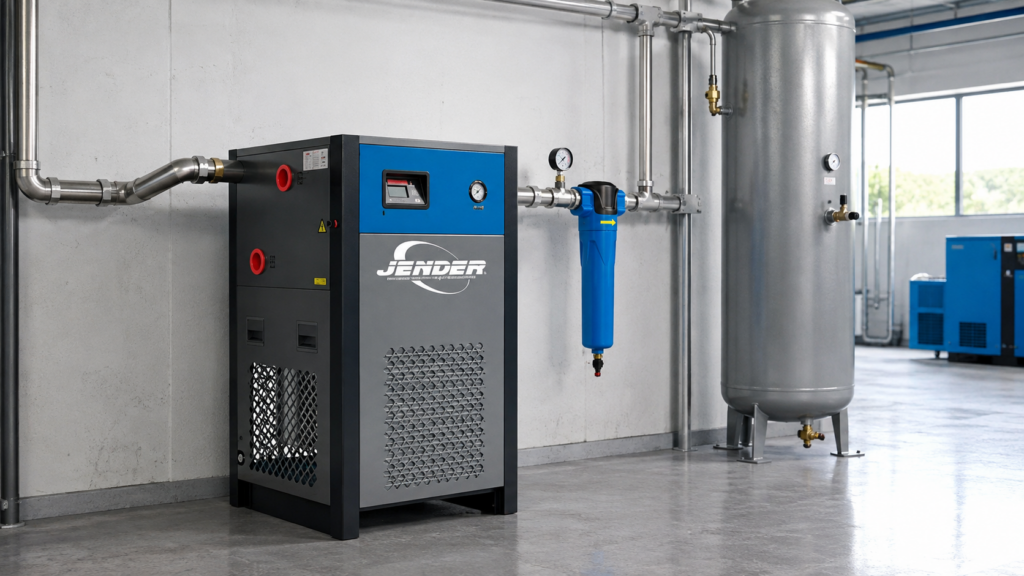
What Type of Dryer Does Your System Need?
The choice depends on the dew point required by your process. For most general industrial applications, a refrigeration-type compressed air dryer is more than sufficient and the most cost-effective option. Only when the process requires very dry air (due to regulations, the risk of freezing, or contact with the product) is an adsorption dryer justified. Oversizing the dryer is a waste of money, and undersizing it puts the entire system at risk: that’s why it’s important to size it according to the actual flow rate and operating conditions.
Where to Place the Dryer During Installation
The dryer is installed after the compressor and the air receiver, and before the fine filters and the distribution network. This placement is no accident: the upstream air receiver allows the air to arrive cooler and with some of the moisture already removed, so that the dryer operates under less load. Placing it in the wrong order—for example, before the air receiver or after the air has been distributed throughout the facility—reduces its effectiveness and allows moisture to reach the points of use. In well-designed systems, the sequence is always compressor, air receiver, dryer, filters, and distribution network.
What kind of maintenance does a compressed air dryer need?
A refrigeration dryer requires simple but consistent maintenance: check that the condensate drain is properly evacuating water, clean the condenser so it dissipates heat effectively, and periodically verify that it maintains the correct dew point. An adsorption dryer also requires replacing the desiccant material from time to time. Neglecting this maintenance is one of the most common reasons why water reappears in the system despite having a dryer installed, especially in the summer, when humidity levels are higher.
The dryer within the compressed air system
The dryer does not operate in isolation: it is part of a treatment chain that includes filters, condensate drains, and separators. In many systems, the dryer is also integrated with the compressor itself. This is the case with some screw compressors that come factory-equipped with the receiver and refrigerant dryer in a single compact unit, which simplifies installation and ensures that the air is treated right from the source. Choosing the right combination of compressor, dryer, and filtration is what ensures dry, stable air at every point of use.
Do you need to dehumidify the air in your facility? We can help.
At Jender, we manufacture compressors and air treatment equipment, and we help you choose the right air dryer for the airflow and air quality you need—without overpaying or settling for less. With technical service throughout Spain, we keep your system running and your air consistently dry. Tell us about your system, and we’ll prepare a customized proposal for you.



