
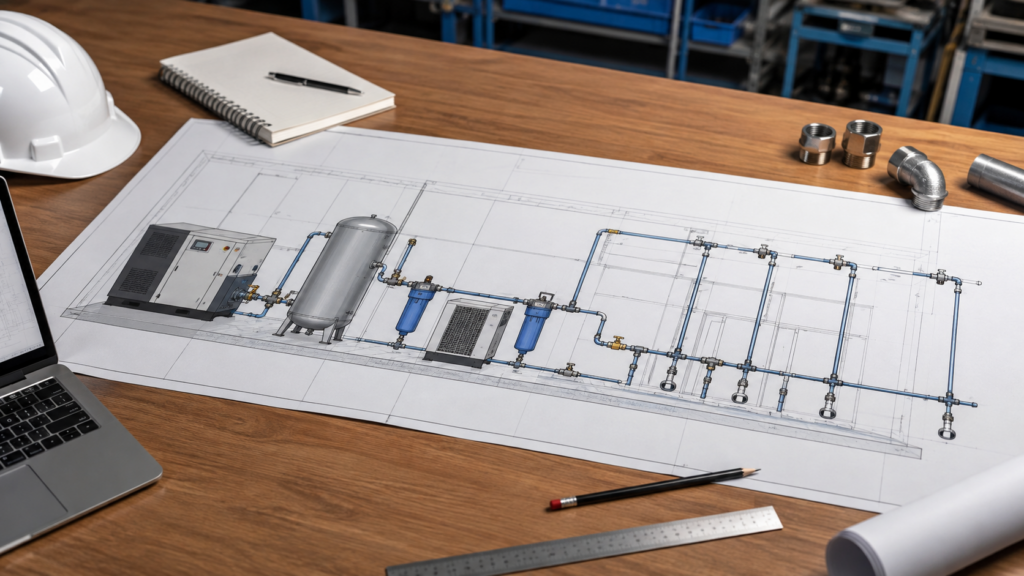
The diagram of a compressed air system shows the path the air takes from the compressor, where it is generated, to each point of use—where it arrives after being treated—passing through the air receiver, the dryer, the filters, and the distribution network. Understanding this diagram and the correct sequence of each component is essential, because a misplaced component can cause the entire system to lose efficiency or result in air containing moisture and impurities.
In this guide, we go over each component of the diagram—including the order in which they are arranged and why—so you can understand how to design a well-planned compressed air system.
The Components of a Compressed Air System
A complete system consists of several components that work in sequence. These are, in the order in which the air passes through them:
1. Compressor. It is the heart of the system. It draws in ambient air and compresses it to the operating pressure. It can be a piston-type or screw-type compressor, depending on the application.
2. Boiler or tank. It stores compressed air, stabilizes the pressure, and absorbs peaks in demand. It also allows an initial portion of the moisture to condense and settle.
3. Hair dryer. It removes moisture from the air to prevent condensation in the system. A refrigeration dryer is the most common type.
4. Filters. They trap particles, oil aerosols, and other impurities. They are typically installed in series, with varying degrees of filtration depending on the required air quality.
5. Condensate drains. They drain the water that has accumulated in the boiler and at the lowest points in the system.
6. Distribution network. The ductwork—usually made of aluminum—that carries air to each outlet, along with its branches, downspouts, and vents.
The Correct Order of the Outline and Why It Matters
The order of the components is not arbitrary. The air must flow through the system in the sequence compressor → receiver tank → dryer → filters → network, because each stage prepares the air for the next one. For example, the receiver tank before the dryer allows the air to arrive cooler and with some of the moisture already removed, which helps the dryer work more efficiently. And the filters after the dryer retain impurities without becoming saturated with water. Altering this order reduces the efficiency of the treatment and shortens the service life of the components.
A key principle is the downward slope and the intakes at the top of the pipe: the main line is installed with a slight slope so that the condensate flows toward the drain points, and the branch lines to the equipment emerge from the top of the pipe, so that water does not flow down toward the tools.
Typical Diagram of a Compressed Air System
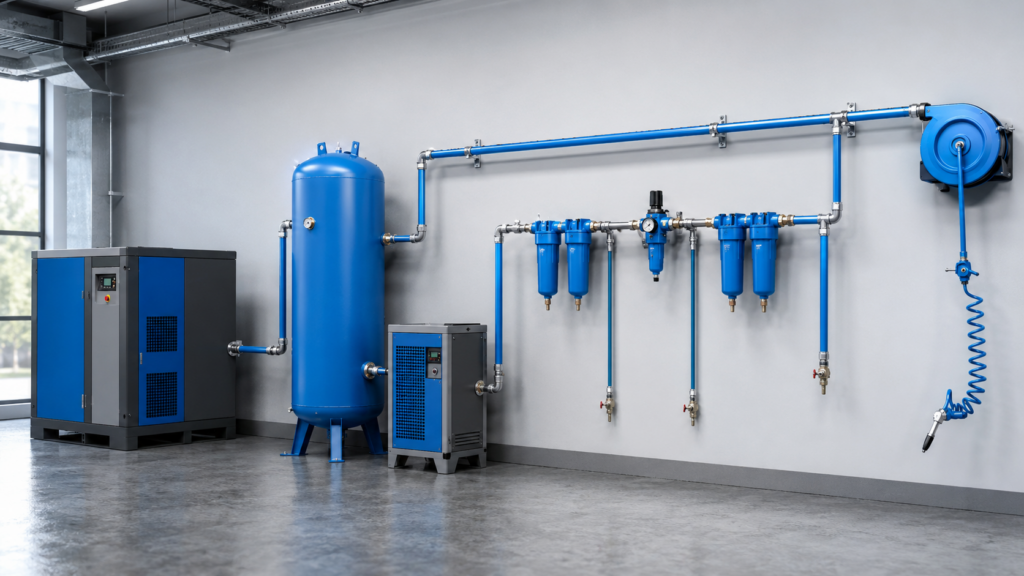
In a standard installation, air flows from the compressor to the receiver tank, where it accumulates and stabilizes. From there, it passes through the refrigeration dryer, which removes moisture, and then through filters that remove particles and oil. Once treated, the air enters the aluminum distribution network, which distributes it throughout the facility via a loop or branch lines to each point of use, with drains at the lowest points to remove any residual condensate. This basic layout is then adapted to the size of the facility, the airflow rate, and the air quality required by each process.
Network topology: ring or tree
The distribution network can be designed in two ways. In a closed-loop system, the piping forms a circuit that surrounds the facility, which distributes pressure more evenly and ensures a constant supply even if demand increases at a single point. In a branched (herringbone) distribution system, a main line feeds offshoots to each zone; this is simpler and more economical, suitable for small facilities or moderate consumption. The choice depends on the size of the installation and the required pressure uniformity.
Design Your Installation with Jender
Every facility is different, and a good design starts with accurate calculations of flow rates, pressures, and layout. At Jender, we design and install complete compressed air systems, or we can supply all the components if you have your own installer—with the guarantee of properly treated air at every point of use. Tell us about your facility, and we’ll prepare a customized layout and quote for you.



