
An air compressor uses a lubricating oil specifically designed for compressors, without detergent additives, with a viscosity that typically ranges between ISO VG 68 and ISO VG 100 (equivalent to SAE 30 or SAE 40, depending on the operating temperature). Car engine oil should never be used: its detergents create carbon deposits that damage the compressor. However, the exact type of oil depends on the type of compressor and its application, and that’s where you need to be specific.
Choosing the right lubricant is no small matter: it’s what separates a compressor that lasts for years from one that breaks down prematurely. In this guide, you’ll learn what type of oil to use based on your equipment, how to interpret viscosity, and what mistakes to avoid.
Why a compressor needs a specific type of oil
The oil in a compressor serves several functions at once: it lubricates moving parts (pistons or rotors), seals internal spaces to prevent pressure from escaping, cools the unit by dissipating heat generated during compression, and protects against corrosion and oxidation. In a screw compressor, moreover, the oil is in direct contact with the air at temperatures exceeding 90 °C, so it must withstand those conditions without degrading.
That is why compressor oils are formulated without detergents and have low ash and sulfur content—exactly the opposite of automotive oil. An unsuitable lubricant not only performs worse—it can also drastically shorten the equipment’s service life.
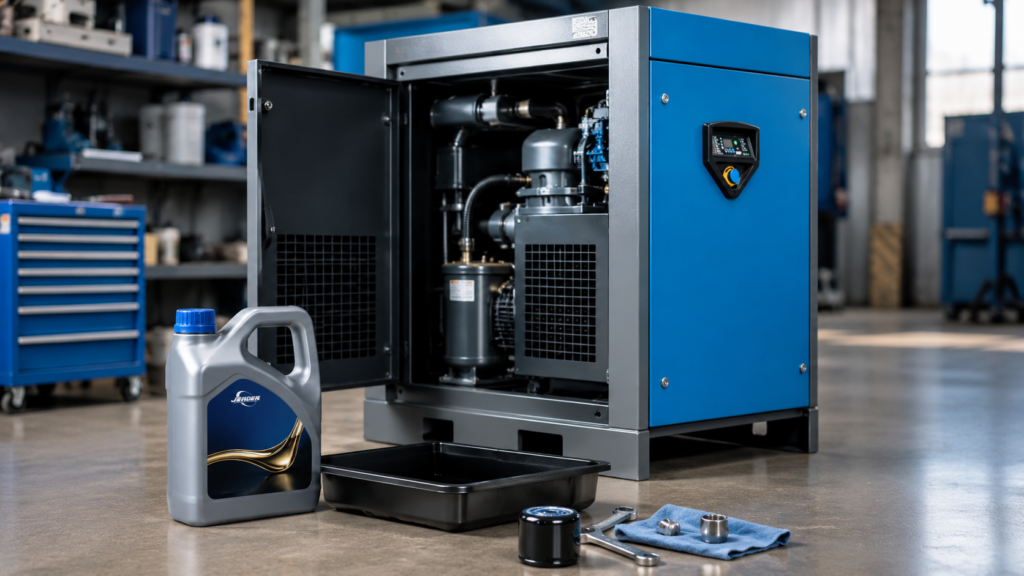
Types of Oil for Air Compressors
There are three main categories, and the choice depends primarily on how often you’ll use it.
Mineral oil. Derived from refined petroleum, it is the most economical option and sufficient for small compressors or those used in the home and for occasional use. It requires more frequent changes.
Synthetic oil. Formulated in a laboratory, it offers greater thermal stability, longer life, and better performance in cold conditions and during continuous operation. It is recommended for industrial and professional use, as well as for screw compressors that operate for many hours at a time.
Semi-synthetic oil. A middle ground between the two previous options, for demanding applications that do not reach the purely industrial level.
There is also food-grade oil, which is required when compressed air comes into contact with food, as well as specific oils for particular applications. If your process involves such applications, the choice of lubricant is a key factor in meeting the required air quality standards.
Viscosity: ISO VG and SAE Explained
Viscosity indicates how “thick” the oil is and is the most important factor when choosing it. It is expressed in two equivalent ways: the ISO VG scale (commonly used in industry) and the SAE scale (more widely known in the automotive industry). For compressors, the most common grades are ISO VG 68 and ISO VG 100, which correspond approximately to SAE 30 and SAE 40.
| ISO VG Viscosity | SAE Equivalent | Recommended Use |
|---|---|---|
| ISO VG 32 | SAE 10 | Very cold environments or starting at low temperatures |
| ISO VG 46–68 | SAE 20-30 | Screw compressors (recommended standard value) |
| ISO VG 68–100 | SAE 30-40 | Piston Compressors and Hot Environments |
As a general rule, a higher viscosity is recommended at higher ambient temperatures, and a lower viscosity at lower temperatures. In any case, the manufacturer’s manual for your equipment is always the definitive guide.
What kind of oil does a piston compressor use?
Piston compressors, which are used more intermittently, generally work well with a mineral or semisynthetic oil with an ISO VG 100 (SAE 40) viscosity rating, without detergents. In cold environments, you can use an ISO VG 68 oil. These units can tolerate somewhat simpler oils because they do not operate continuously. You can view the range of industrial piston compressors and their specifications to identify the appropriate lubricant for each model.
What kind of oil does a screw compressor use?
Screw compressors, designed to operate for many consecutive hours, almost always require a synthetic oil with an ISO VG 46 or 68 viscosity grade, which is more resistant to high temperatures and has longer oil change intervals. Since the oil is in constant contact with hot air, the quality of the lubricant is even more critical than in a piston compressor. For its line of industrial screw air compressors, the manufacturer specifies the type of oil and the recommended change interval for each unit.
Can you use 15W40 or 10W30 oil in a compressor?
This is one of the most common questions, and the short answer is that it’s not recommended. Multigrade automotive oils such as 15W40, 10W30, or 5W30 are formulated with detergent and dispersant additives designed for a car’s engine, not for a compressor. In a compressor, these additives create carbon deposits and sludge that build up on valves and in the compression chamber. In a one-time emergency, they might get you out of a bind, but as a general rule, you should use a specific compressor oil without detergents. The only automotive viscosity grade that is sometimes acceptable in small piston compressors is a single-grade SAE 30 without additives, but a specific compressor lubricant is always preferable.
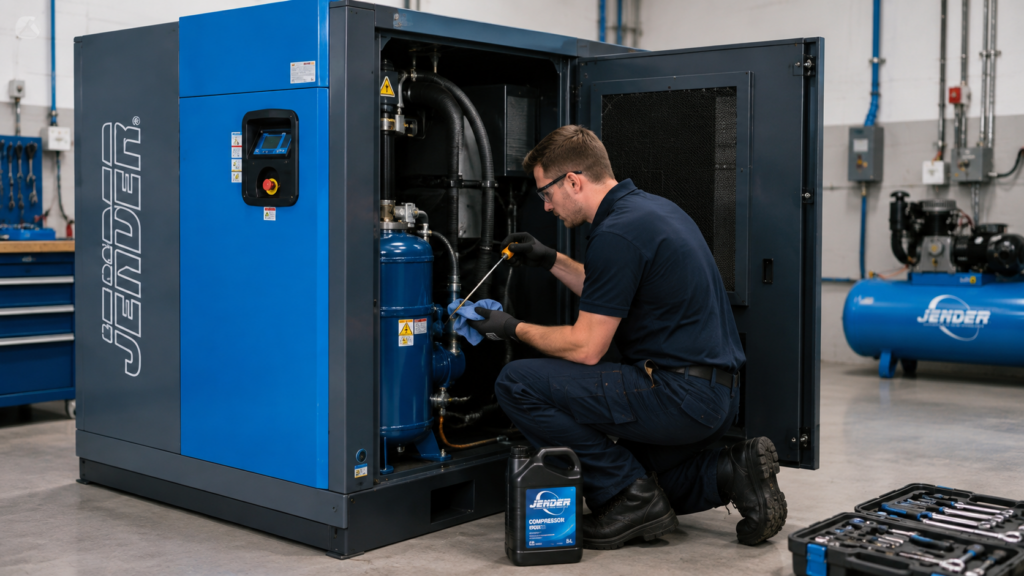
Common Mistakes When Choosing Compressor Oil
The most common—and most serious—mistake is using automotive engine oil for the reasons we just discussed. Other common mistakes include mixing mineral oil with synthetic oil (they may be incompatible and lose their properties), ignoring the manufacturer’s recommended viscosity, reusing old oil, or refilling without checking the level on the sight glass. And here’s an important exception that many people overlook: if your compressor is “oil-free,” you must not add any lubricant, because its mechanism is designed to run dry.
How much oil does an air compressor hold?
There is no universal amount: each model has its own specific capacity, which is indicated in the equipment manual. In small piston compressors, it typically ranges from 0.3 to 0.6 liters, while industrial screw compressors handle much larger volumes. What matters is not so much the exact figure as staying within the level marked on the sight glass: neither below it (which causes a lack of lubrication) nor above it (since excess oil causes foaming and oil carryover into the air). The reference point is usually around the middle of the sight glass, with the compressor shut off and cold.
How often should the compressor oil be changed?
The frequency depends on the type of oil and the number of hours of use, but as a general guideline, mineral oil is usually changed more frequently than synthetic oil, which lasts for more hours of operation. The key is to follow the intervals specified in each piece of equipment’s manual and check the oil level through the sight glass before each use. A timely oil change is the most cost-effective maintenance task and the one that extends the compressor’s lifespan the most.
Questions about your compressor oil? Contact us
At Jender, we manufacture screw and piston compressors, and we know exactly which lubricant each unit requires. If you have questions about the oil, the oil level, or the oil change interval for your compressor, our technical team will advise you and provide you with genuine replacement parts, with service available throughout Spain. Tell us which model you have, and we’ll let you know exactly which oil it needs.



