
CFM ( cubic feet per minute) is the unit used to measure the air flow delivered by a compressor—that is, the volume of air it is capable of supplying each minute. It is one of the most important factors to consider when choosing a compressor, because it determines whether it will be able to power your tools or your process without falling short. Simply put: pressure (bar or psi) indicates how forcefully the air is delivered, and CFM indicates how much air is delivered.
Understanding CFM is key to avoiding the purchase of the wrong compressor. A unit with high pressure but low airflow may be unable to power a tool that consumes a lot of air, and that is one of the most common mistakes people make when choosing a compressor.
CFM, pressure, and power: they are not the same thing
These three concepts are often confused, but they measure different things. CFM (air flow) is the volume of air per minute. Pressure (in bar or psi) is the force with which that air is delivered. And power (in CV or kW) is the energy of the motor that drives the compressor. A compressor may have high power and pressure, but if its CFM is low, it won’t be able to keep a tool running that requires a high, continuous air flow. When choosing a compressor, you need to consider all three factors, but CFM is the one most often overlooked.
CFM Equivalents in Other Units
CFM is an imperial unit, so in Europe it’s helpful to know how to convert it to the units we commonly use: liters per minute (l/min) and cubic meters per hour (m³/h).
| Unit | Approximate equivalence |
|---|---|
| 1 CFM | 28.32 liters per minute (l/min) |
| 1 CFM | 1,699 cubic meters per hour (m³/h) |
| 1 m³/h | 0.589 CFM |
As a quick reference, to convert from CFM to liters per minute, simply multiply by 28.32. Thus, a 10 CFM compressor delivers about 283 liters of air per minute.
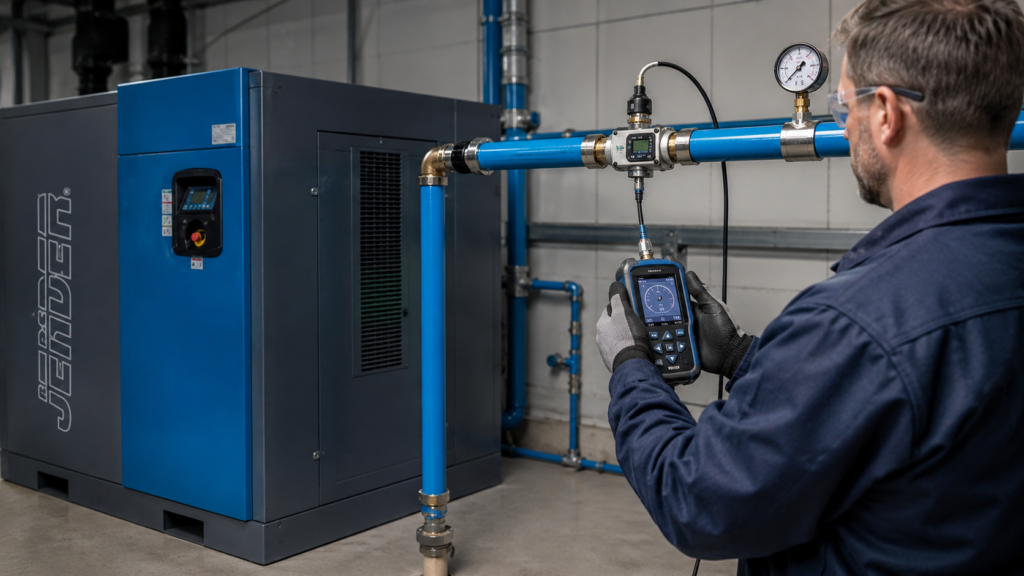
Why is CFM a key factor when choosing a compressor?
Each pneumatic tool has an air consumption rating expressed in CFM (or l/min). For a compressor to function properly, its airflow must be equal to or greater than the sum of the air consumption of the tools that will be used simultaneously, with a safety margin. If the compressor’s CFM is lower than what the tools require, the tools will lose power, operate erratically, or simply fail to perform. Therefore, before purchasing, it’s best to add up the consumption of all simultaneous points of use and choose a compressor that comfortably exceeds that total.
Actual CFM vs. Theoretical CFM
An important detail that many technical specifications fail to make clear: the amount of air a compressor displaces in theory is not the same as the amount it actually delivers. The theoretical flow rate (displacement) is always greater than the actual flow rate available at the outlet—which is what really matters. When comparing equipment, it’s best to look at the effective flow rate at a specific working pressure, rather than the theoretical figure, to avoid any surprises.
How to Determine the CFM You Need
The correct way to size a system is to start with the air consumption, not the compressor. Make a list of the tools or equipment you’ll be powering, note the air consumption of each one, add up those that will be used at the same time, and add a 20–30% margin to account for future expansions and to compensate for possible leaks. The result is the minimum CFM your compressor must deliver at your operating pressure. If you have any questions, you can check the airflow rating for each model in Jender’s line of industrial piston compressors to find the one that best suits your needs.
Not sure what flow rate you need? We’re here to help.
Choosing a compressor with the right airflow capacity prevents you from falling short—and also from overpaying for oversized equipment. At Jender, we manufacture compressors for every level of demand, and our technical team can analyze your actual consumption and recommend the exact model you need. Tell us which tools or processes you’ll be powering, and we’ll help you make the right choice.



